

Absolutely. Certain water filters are fantastic at removing fluoride, and if you’re looking for the most effective method, reverse osmosis systems are your best bet. While a lot of standard filters do a great job of making your water taste better by getting rid of chlorine, they won’t touch fluoride. It’s a completely different challenge, so you need the right tool for the job.
Why Some Aussies Choose to Filter Out Fluoride
For decades, adding fluoride to our water has been a key part of Australia's public health strategy. It's credited with a massive drop in tooth decay rates nationwide, and the idea is simple: adding a controlled amount of fluoride to the water supply helps strengthen tooth enamel and fight off cavities. This approach has widespread support for its dental benefits, particularly for kids.
However, a growing number of Australians are looking to take more control over what’s in their glass, which leads them to ask what kind of water filter can actually remove fluoride. This isn’t necessarily about rejecting the benefits of fluoridation. Often, it’s about personal choice and wanting to manage the total amount of fluoride they get from all sources—including toothpaste, certain foods, and other drinks.
Understanding Fluoride Levels Across Australia
One of the big reasons people are taking matters into their own hands is how much fluoridation varies across the country. Most major cities have fluoridated water, but things can be very different in regional areas or even from one council to the next. In many states, artificially fluoridated water is supplied to 70% or more of the population, but it's not a uniform picture. Queensland, for example, is a real patchwork, where local councils get the final say, creating a mix of fluoridated and non-fluoridated communities living side-by-side.
This inconsistency means the fluoride level in your tap water really depends on your postcode, making it tough to keep track of how much you’re actually consuming. For families in areas where fluoride levels are naturally high, or for those who simply want to be in the driver's seat, installing a dedicated filter is a pretty practical step.
For many, the decision to filter fluoride is about exercising personal sovereignty over their health and consumption. It's a move toward customising their water to meet their family's specific needs and preferences, rather than a blanket opposition to public health initiatives.
The Drive for Personalised Water Quality
The conversation around water quality has moved way beyond just "is it safe to drink?". People are more aware than ever about the different substances in their tap water and are looking for ways to purify it to their own standards. For some, that means removing additives like both chlorine and fluoride to get a taste and composition that feels more natural to them.
Concerns about long-term exposure also play a part. Beyond just teeth, some people look into the broader effects on skeletal structure, which might lead them to research things like supplements for bone healing and health. While public health bodies assure us that current levels are perfectly safe, having the choice to filter offers peace of mind. To get a better handle on all the different viewpoints, you can learn more about the effects of water fluoridation in our detailed guide.
At the end of the day, it's all about achieving water that is clean, safe, and tastes great—and that aligns with your personal health philosophy.
How Fluoride Removal Technologies Actually Work
To find a water filter that genuinely removes fluoride, you need to look past the marketing slogans and understand what’s happening inside the system. Not all filters are created equal. The technologies powerful enough to capture tiny fluoride ions are completely different from standard filters that just make your water taste and smell a bit better.
Let's break down the science behind the most effective methods. Think of these as highly specialised tools, not simple sponges. Some act like an ultra-fine sieve, while others work like a powerful magnet. Understanding these differences is the key to choosing a system that truly meets your needs.
Reverse Osmosis: The Ultimate Gatekeeper
Reverse osmosis (RO) is widely considered the gold standard for removing fluoride from drinking water in Australia, and for good reason. Imagine your tap water being pushed through a security checkpoint so strict it only allows pure water molecules to pass. That's pretty much how an RO membrane works.
This special membrane has microscopic pores, roughly 0.0001 microns in size. To put that in perspective, a single human hair is about 70 microns thick. Fluoride ions, along with other dissolved salts, heavy metals, and contaminants, are simply too large to squeeze through these tiny openings.
Water pressure forces the pure H₂O molecules through, while all the rejected contaminants are collected and flushed away as wastewater. The result? This process is incredibly effective, purifying water right down to the molecular level. It’s no surprise that RO systems can remove between 96-99% of fluoride, a rate that far exceeds most other filtration methods.
This infographic helps visualise the journey from broad public health measures to individual household choices when it comes to managing fluoride in your tap water.
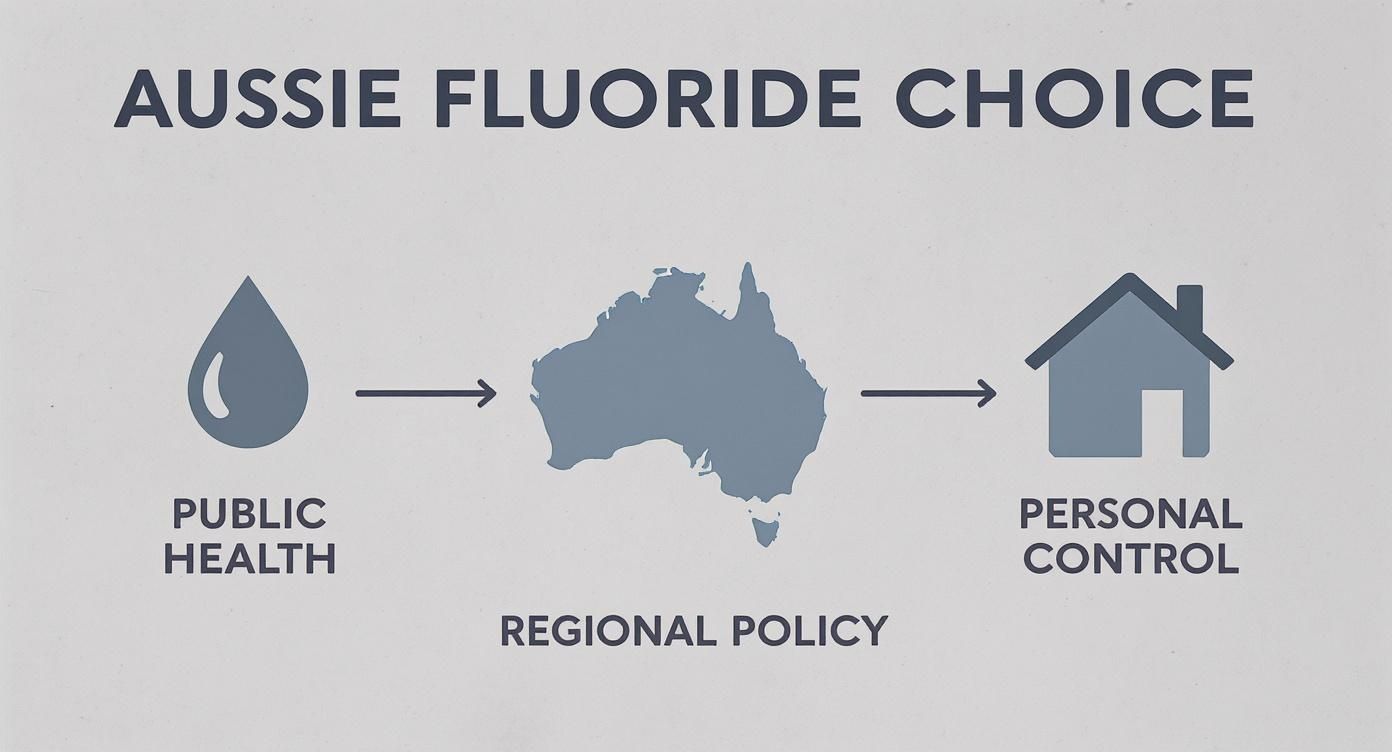
It shows how national health policies are applied at a local level, which ultimately leads many Aussies to seek personal control over their water quality with a dedicated filtration system.
Fluoride Removal Methods At a Glance
Feeling a bit overwhelmed by the options? Don't be. This table gives you a quick side-by-side comparison of the top fluoride removal technologies. It's a handy cheat sheet to see how each method stacks up in terms of effectiveness, how it works, and its main pros and cons.
| Filtration Technology | Typical Removal Rate | How It Works | Primary Advantage | Main Consideration |
|---|---|---|---|---|
| Reverse Osmosis | 96-99% | Pushes water through a semi-permeable membrane that blocks fluoride ions. | Extremely high purity and removes many contaminants. | Slower process; produces wastewater. |
| Activated Alumina | Up to 90% | Fluoride ions chemically stick to the porous alumina media (adsorption). | Highly effective and specifically targets fluoride. | Performance depends on water pH. |
| Bone Char | Up to 90% | Uses hydroxyapatite to exchange fluoride ions for hydroxide ions. | Natural media with a high capacity for fluoride. | Sourced from animal bones; may not suit everyone. |
| Distillation | Over 99% | Boils water into steam, leaving fluoride behind, then condenses it back. | Produces exceptionally pure water. | Slow, uses a lot of electricity, removes minerals. |
Each of these technologies offers a solid path to fluoride-free water, but as you can see, the right choice often comes down to balancing performance with practical considerations like maintenance, cost, and household needs.
Activated Alumina: The Fluoride Magnet
Another powerful technology is Activated Alumina. Don't let the name intimidate you; its function is actually pretty straightforward.
Think of it as a specialised magnet designed specifically to attract and hold onto fluoride. The filter media is made of porous aluminium oxide, which has a massive surface area covered in sites that fluoride ions are chemically drawn to.
As water flows through the activated alumina cartridge, a process called adsorption takes place. This isn't the same as absorption (like a sponge soaking up water). Instead, the fluoride ions literally "stick" to the surface of the media, getting pulled out of the water stream.
This method is highly effective, often removing up to 90% of fluoride. However, its performance really depends on the water's pH level—it works best in slightly acidic water. Once the media becomes saturated with fluoride, it loses its effectiveness and the cartridge has to be replaced.
Bone Char: A Natural Adsorbent
Bone char, sometimes known as natural carbon, is one of the oldest methods used for water defluoridation. It’s made from charred animal bones and works in a similar way to activated alumina, using adsorption to capture fluoride.
The key component here is hydroxyapatite, which has a strong, natural affinity for fluoride ions. As water passes through the bone char, fluoride ions are exchanged for hydroxide ions on the surface of the hydroxyapatite. This effectively locks the fluoride onto the filter media while releasing harmless hydroxide into the water.
- Natural Origin: It's a more natural alternative to some synthetic filter media.
- High Capacity: Bone char has a high capacity for fluoride, meaning a single cartridge can last a decent amount of time.
- Effectiveness: It can reliably remove up to 90% of fluoride under the right conditions.
Understanding all the different techniques is crucial. If you're exploring your options, our guide on how to remove fluoride from water offers even more practical advice.
Distillation: The Boiling and Condensing Method
Water distillation is a completely different approach that mimics the Earth’s natural water cycle. It's less of a filter and more of a total purification process.
The system works by boiling water to create steam. This leaves nearly all contaminants behind—including fluoride, heavy metals, and bacteria—because they can't evaporate. The pure water vapour is then collected and cooled in a separate chamber, where it condenses back into liquid. The result is extremely pure water, virtually free of any dissolved solids.
While highly effective at removing fluoride (often over 99%), distillation comes with some practical drawbacks. The process is slow, uses a fair bit of electricity, and removes all minerals from the water, which some people find gives it a flat taste. For these reasons, it’s less common for everyday household drinking water compared to reverse osmosis or activated alumina systems.
Alright, you've got a handle on the different technologies that can tackle fluoride. That’s the first big step. Now for the fun part: figuring out which system actually fits into your kitchen, your lifestyle, and your budget.
Choosing the right filter isn't just about the tech specs; it's about balancing powerful filtration with everyday practicality. In Australia, fluoride removal systems typically come in three main flavours: benchtop units, under-sink systems, and whole-house solutions. Each one has its own set of perks and is designed for different living situations, whether you're renting a flat in Melbourne or own a family home out in the suburbs.
Let's break them down so you can find the perfect match.
Benchtop Filters: Simplicity and Portability
Benchtop water filters are easily the simplest way to get started with fluoride removal. As the name suggests, these units sit right on your kitchen counter and require virtually no installation. You just connect a small tube to your tap, and a little diverter valve lets you switch between filtered and unfiltered water with a quick flick.
This makes them a brilliant choice for renters or anyone who doesn't want to mess with their plumbing. Plus, they’re portable, so if you move house, your filter can come with you.
- Best For: Renters, students, smaller households, or anyone looking for a no-fuss setup.
- Pros: Super affordable upfront, installs in minutes, and completely portable.
- Cons: They do take up precious counter space and usually have a slower flow rate than more permanent systems.
Under-Sink Systems: The Hidden Powerhouse
If you’re after a more permanent and powerful solution that stays out of sight, an under-sink system is probably your best bet. These units are installed neatly in the cupboard under your kitchen sink and hook directly into your cold water line. You get beautifully filtered water from a dedicated, stylish tap that sits right next to your main one.
Under-sink systems are where you'll find the heavy hitters like reverse osmosis (RO) technology, which offers the highest rates of fluoride removal. By tucking the system away, you keep your kitchen looking clean and uncluttered while getting top-tier purification on demand.
While they do need a bit more installation work—often a job for a plumber—under-sink systems give you a seamless and incredibly effective way to get fluoride-free water straight from the tap.
Whole-House Systems: The Ultimate Water Solution
For the most comprehensive approach, nothing beats a whole-house filtration system. Also known as a point-of-entry (POE) system, this unit is installed where your main water line enters your property. It treats every single drop of water you use—in every tap, shower, and appliance. That means you get filtered water not just for drinking, but for bathing, cooking, and laundry, too.
This is the ultimate upgrade for your home's water quality, but it's also the biggest investment. A whole-house system that effectively removes fluoride requires careful planning and professional installation. It's a fantastic choice for homeowners who are serious about ensuring the highest quality water throughout their entire property.
Deciding between these options really comes down to your personal situation. To get a more detailed breakdown of what might work for you, take a look at our guide on choosing the right water filtration system for your home or business. It’ll help you weigh up all the pros and cons.
What Standard Carbon Filters Will Not Remove
It's one of the most common mistakes people make when trying to filter their water. You've probably got a filter pitcher in the fridge or a basic filter on your tap, and it’s easy to assume it’s taking care of everything – including fluoride. Unfortunately, this is a huge misunderstanding that gives a lot of people a false sense of security.
Standard water filters, especially the popular and affordable ones you see everywhere, almost always use activated carbon. This stuff is an absolute powerhouse for getting rid of the nasty taste and smell from your tap water. It does a fantastic job at what it's designed for.
Think of activated carbon as a sponge with an incredibly vast, porous surface. As water passes through, bigger contaminants like chlorine and volatile organic compounds (VOCs) get snagged in all these tiny nooks and crannies. This process, called adsorption, is exactly why a simple carbon filter can make your water taste so crisp and clean.
Why Fluoride Slips Through the Cracks
Here’s the catch: fluoride ions are completely different from chlorine molecules. Fluoride is a dissolved mineral, which means it’s fully integrated into the water on an ionic level. Standard activated carbon just doesn't have the right chemical properties to attract and hold onto these tiny, dissolved particles.
To put it another way, using a standard carbon filter to remove fluoride is like trying to catch fine sand with a fishing net. The big rocks (like chlorine) get caught easily, but the tiny grains of sand (fluoride) slip right through without any trouble.
This means that while your water might taste a whole lot better, its fluoride level is virtually unchanged. If your main goal is to cut down your fluoride intake, a standard carbon filter simply isn't the right tool for the job.
This distinction is critical. Many households believe their current filter provides comprehensive protection, but for dissolved minerals like fluoride, specialised technology is essential. Relying on a standard carbon filter for this task is a common but significant pitfall.
To get a better handle on what these filters are brilliant at, you can check out our detailed guide explaining what a carbon water filter is and how it works.
Contaminants Carbon Filters Are Great At Removing
While they won’t touch fluoride, it's worth knowing what activated carbon filters are exceptionally good at removing from Australian tap water:
- Chlorine: This is the main culprit behind that "chemical" taste or swimming pool smell. Carbon is extremely effective at adsorbing it.
- Volatile Organic Compounds (VOCs): These can include a range of chemicals from industrial and agricultural runoff.
- Pesticides and Herbicides: Carbon can seriously reduce the levels of certain agricultural chemicals that might find their way into the water supply.
- Taste and Odour: By tackling the contaminants above, carbon filters massively improve how your drinking water tastes and smells.
So, while your pitcher or fridge filter is definitely doing a valuable job, you need a different approach if fluoride is your main concern. This means looking into technologies like reverse osmosis, activated alumina, or bone char, which are specifically engineered to capture those tricky dissolved minerals.
Understanding the True Cost of Your Filter
When you start shopping for a water filter to remove fluoride, it's all too easy to let the initial price tag guide your decision. But that sticker price? It’s just the beginning of the story. To make a smart investment, you need to look at the total cost of ownership – what the system will actually cost you over its entire life.
This includes the upfront purchase, of course, but more importantly, the ongoing expense of replacement parts like filter cartridges and membranes. Some systems might look like a bargain at first, but if they need frequent and expensive filter changes, they can quickly become a money pit. Sometimes, a pricier initial purchase ends up being the more economical choice in the long run.
Let's break down the real numbers behind owning a fluoride removal system in Australia.
Upfront Investment vs Long-Term Maintenance
The initial cost is the most obvious part. This can be anything from under a hundred dollars for a basic gravity-fed benchtop unit to several thousand for a full-blown whole-house system. While grabbing the cheapest option is tempting, it can be a classic case of false economy.
For example, a low-cost benchtop filter might need a new cartridge every three months. In contrast, a more expensive under-sink reverse osmosis system might only need its pre-filters changed once a year and a new membrane every few years. Tallying up these recurring costs is the only way to understand the true financial commitment.
The most cost-effective water filter isn’t always the one with the lowest initial price. It’s the one that balances upfront cost with affordable, long-term maintenance, providing you with consistent, high-quality water without surprise expenses.
A great way to compare different systems is to think about the cost per litre. A higher-capacity filter, though more expensive to buy, often delivers a much lower cost for every litre of pure water it produces over time, giving you far better value.
Estimated Annual Cost of Ownership for Fluoride Water Filters
To give you a clearer picture, we've put together some typical costs for different fluoride removal systems here in Australia. This table gives a realistic breakdown of what you can expect to pay, both upfront and for yearly maintenance.
| System Type | Typical Upfront Cost (AUD) | Annual Maintenance Cost (AUD) | Cost Per Litre (Estimate) |
|---|---|---|---|
| Benchtop (Gravity/Ceramic) | $80 – $250 | $60 – $150 | $0.05 – $0.10 |
| Benchtop (Countertop Unit) | $300 – $600 | $100 – $200 | $0.03 – $0.07 |
| Under-Sink (Reverse Osmosis) | $450 – $900 | $120 – $250 | $0.02 – $0.05 |
| Whole-House System | $1,500 – $4,000+ | $300 – $600+ | < $0.01 |
As you can see, a whole-house system is a significant initial investment, but its cost per litre is incredibly low since it treats every drop of water entering your home. For most households just wanting to purify their drinking water, an under-sink reverse osmosis system often hits the sweet spot between top-tier performance and manageable long-term costs.
Factoring in Installation and Other Expenses
Beyond the system and its filters, there are a few other potential costs you'll want to keep in mind.
- Installation: Benchtop units are usually a simple DIY job, costing you nothing more than a few minutes of your time. Under-sink and whole-house systems, however, often need a professional plumber. This can add $150 to $500 or more to your initial outlay, depending on how complex the job is.
- Wastewater (for RO systems): Reverse osmosis systems create wastewater as part of their purification process. While modern, efficient systems have cut down this waste dramatically, it will still add a small—and often negligible—amount to your water bill.
- Electricity: Some systems, like water distillers and pumped RO units, need electricity to run. This will add a minor ongoing cost to your power bill. Most standard RO and activated alumina systems, on the other hand, are non-powered.
By weighing up all these factors—the initial purchase, filter replacements, installation, and running costs—you get the complete financial picture. This empowers you to choose a water filter to remove fluoride that not only fits your budget today but also delivers sustainable, affordable, and pure water for years to come.
How to Choose a Certified and Reliable Filter
Navigating the world of water filters can feel a bit overwhelming, especially when you're trying to find one that properly removes fluoride. But it doesn't have to be. The trick is to focus on certifications and performance data to find a reliable choice. You're looking for proof, not just promises.
In the water filtration industry, NSF/ANSI certifications are the gold standard. Think of them as a guarantee that a filter has been put through its paces and tested against strict public health and safety standards. For fluoride removal, you'll want to keep an eye out for NSF/ANSI 58 (specifically for reverse osmosis systems) or NSF/ANSI 53, which covers filters designed to reduce specific health-related nasties like fluoride.
Read the Fine Print
Every reputable filter should come with what’s called a Performance Data Sheet. This document is your best friend when comparing systems. Don't just take the marketing claims on the box at face value; this sheet gives you the hard numbers, spelling out exactly which contaminants the filter is certified to reduce and by how much.
Scan that list for fluoride and check the specific reduction rate. This is how you confirm you're buying an effective water filter to remove fluoride and not just a simple taste-and-odour filter. A high-quality system will be proud to show off its proven performance.
Buying Smart in Australia
Choosing the right filter also means choosing a supplier who’ll have your back for the long haul. Here in Australia, there are a few key things to look for:
- WaterMark Certification: This is a big one. For any product that connects to your home's plumbing, like an under-sink system, this certification is a legal requirement. It ensures the product is safe and fit for purpose in Australia. You can learn more about why WaterMark is important for water filters.
- Reputable Suppliers: Stick with established Australian companies that offer solid warranties, easy-to-reach customer support, and a reliable stock of replacement cartridges.
- Availability of Parts: Make sure replacement filters and parts are easy to find and won’t break the bank. There's nothing worse than buying a great system only to find the cartridges are impossible to source later on.
Remember, your investment isn't just in the initial system—it's in ongoing access to clean, safe water. A reliable supplier ensures your filter stays effective for its entire lifespan, giving you lasting peace of mind.
Got Questions About Fluoride Filters? We've Got Answers.
Even after you've picked a filtration technology, a few questions might still be nagging at you. That's perfectly normal. Let's tackle some of the most common queries we hear from Aussies looking to filter fluoride, so you can make your final choice with confidence.
Do Fluoride Filters Also Strip Out the Good Minerals?
This is a big one, and it's a valid concern, especially when we're talking about reverse osmosis (RO) systems. The membrane in an RO unit is so incredibly fine that it acts like a bouncer at an exclusive club—it stops almost everything from getting through. That includes fluoride, but it also means healthy minerals like calcium and magnesium get blocked.
The result? The water can taste a bit "flat" or empty. But there's a simple fix. Most quality under-sink RO systems now come with a remineralisation filter. This is the last stage of the process, where a healthy balance of essential minerals is added back into the purified water. It's a game-changer for improving the taste and balancing the pH.
How Do I Know if My Tap Water Even Has Fluoride?
The quickest and most reliable way to find out is to check with your local water authority. Most councils and water suppliers have a section on their website where you can pop in your postcode and get a full water quality report. It’ll tell you straight up if your supply is fluoridated and exactly what the concentration is.
Can I Cook With Fluoride-Filtered Water?
Absolutely! In fact, we highly recommend it. Using filtered water for cooking, brewing your morning coffee, or preparing baby formula is perfectly safe. Many people find it actually improves the flavour of their food and drinks because you're not just removing fluoride, but also chlorine and other contaminants that can give tap water an "off" taste.
A quick tip on installation: If you're looking at an under-sink system, be honest about your comfort level with a bit of plumbing. While many kits are designed for a straightforward DIY job, there's no shame in calling a professional plumber. It guarantees a leak-free setup and gives you total peace of mind.
Ready to enjoy pure, great-tasting water free from fluoride and other nasties? Awesome Water® offers a range of certified filtration systems to suit any Australian home or workplace. Explore our solutions and find your perfect fit today at https://www.awesomewater.com.