
Last Updated: 8 November 2026
Quick Summary
A bore water filtration system with UV treatment works by putting filtration first and UV disinfection last, so sediment and dissolved minerals are removed before the water reaches the lamp. Test your bore water before buying any filter, then match each treatment stage to your lab results.
- Keep turbidity low before the UV stage, as particles shield microorganisms from the light.
- Replace sediment cartridges every 3 to 6 months, sooner if pressure climbs.
- Replace the UV lamp annually, even if it still glows.
- Fit a solenoid shut-off valve so untreated water cannot pass during a power outage.
- The twin large-format UV filtration system costs $1,999.00.
Table of Contents
- Why Bore Water Needs Filtration and UV Treatment
- Bore Water Testing: The First Step Before Any Filter
- Matching Treatment Stages to Your Test Results
- UV Treatment: What It Kills and What It Cannot Remove
- System Options and Pricing for Bore Water Treatment for Drinking
- Installation, Commissioning and Flow Rate Checks
- Bore Water Filter Maintenance and Seasonal Checks
- Choose Your Bore Water System at the Awesome Water Showroom
- Frequently Asked Questions
Why Bore Water Needs Filtration and UV Treatment
Bore water is groundwater drawn from an underground aquifer, and it picks up whatever it passes through on the way.
That makes a bore water filtration system with UV treatment the practical starting point for anyone wanting to drink from a private supply.
Three things drive the need:
- Sediment and turbidity cloud the water and shield microorganisms from UV light
- Dissolved minerals like iron and manganese stain laundry and taste metallic
- Microorganisms including bacteria, viruses and protozoa can enter through surface contamination
The order matters. Sediment first, then dissolved minerals, then UV last. Get that sequence wrong and the whole system underperforms.
Bore Water Testing: The First Step Before Any Filter
Never buy a filter before you test. Bore water testing tells you exactly which treatment stages you need, and skipping it means guessing with your family's drinking water.
A laboratory analysis should cover:
- pH and hardness
- Iron, manganese and salinity
- Turbidity and suspended solids
Collect your sample in a sterile container from a clean tap, not a garden hose. Deliver it to the lab promptly, chilled if required. Results usually take several days.
Reading Your Lab Results Against Drinking Water Guidelines
Compare your report against the Australian Drinking Water Guidelines, published by the National Health and Medical Research Council. The Australian Drinking Water Guidelines set health-based limits for contaminants and aesthetic limits for taste and appearance.
Two numbers matter most for planning:
- Turbidity above roughly 5 NTU starts to interfere with UV performance
- Iron and manganese above aesthetic limits cause staining and taste problems
Your report may flag a contaminant as exceeding the health guideline, or only the aesthetic one. Treat the health exceedances as non-negotiable. Aesthetic ones are about comfort and equipment life.
Matching Treatment Stages to Your Test Results
Here is the decision framework we use. Work down the list and stop when your results are covered.
| Test result | Treatment stage | Why it comes here |
|---|---|---|
| Turbidity, sediment, rust | Sediment pre-filter | Protects later stages from clogging |
| Iron, manganese, tannins | Carbon block or Aragon media | Removes colour, odour and dissolved metals |
| Hardness, salinity | Ion exchange or reverse osmosis | Reduces scale and salty taste |
| Bacteria, viruses, protozoa | UV disinfection | Final barrier after water is clear |
The logic is simple: each stage protects the next. A carbon filter clogged with sediment stops working. A UV lamp behind cloudy water cannot penetrate it.
Sediment and Pre-Filtration
Sediment filtration is the workhorse stage. A polyspun cartridge traps dirt, rust and fine particles before they reach anything expensive.
Most bore setups run two sediment stages: a coarser 50 to 20 micron cartridge first, then a finer 20 to 1 micron cartridge. The coarse one takes the heavy load so the fine one lasts longer. Our replacement polyspun sediment filter fits this stage directly.

Watch out: skipping the coarse stage and running only a fine cartridge means you will replace it constantly.
Iron, Manganese and Tannins
Iron and manganese are the two minerals that ruin bore water fastest. They stain sinks, mark laundry and give water a metallic edge. Tannins from vegetation turn water tea-coloured.
Carbon block media handles colour, odour and organic compounds. Aragon media, a bacteriostatic polymer with silver additives and ion-exchange resin, is listed to target hardness salts, dissolved iron and heavy metals.
UV Treatment: What It Kills and What It Cannot Remove
UV treatment is a disinfection stage, not a filter. Ultraviolet light in the germicidal range damages the genetic material of microorganisms so they cannot reproduce. It inactivates bacteria, viruses and protozoa without adding chemicals or changing taste.
What UV cannot do:
- Remove sediment, iron or manganese
- Fix salty or hard water
- Work through cloudy water
UV Dose, Flow Rate and Water Clarity
UV disinfection is only as good as the dose delivered. Dose is the product of UV intensity and contact time, and it falls when flow rate rises or when the water absorbs or scatters light before it reaches the microbes.
Three operating limits matter most:
- UV transmittance (UVT): the fraction of UV light that passes through the water. Clear water transmits well; water with dissolved organics, iron or tannins absorbs UV before it reaches the lamp.
- Turbidity: suspended particles shield microorganisms. Keep turbidity low before the UV stage, and check the manufacturer's stated limit.
- Flow rate: every reactor has a rated maximum flow at a stated dose. Push water through faster than that and the dose drops, even though the lamp is still lit.
Protozoa such as Cryptosporidium and Giardia are more UV-resistant than bacteria, so check the manufacturer's validation data for the dose at your required flow, not just the lamp wattage.
Watch out: wattage alone does not indicate disinfection performance, so check the rated flow at the validated dose.
Pre-Treatment Is Part of the UV System
The UV reactor is the last barrier, and it only works if the water reaching it is clear. Keeping the reactor clear therefore depends on identifying which contaminants are present and checking them regularly through water testing procedures.
For tank and bore water, our twin large-format UV filtration system combines two sediment stages with a 45-watt Viqua UV lamp in a full enclosure aluminium box. The UVG SLT30 UV system is a standalone UV option.


When UV Is Not Enough
UV does not remove chemicals, salinity or heavy metals, and it does not provide residual protection in the pipework.
UV is also ineffective if the water is turbid, if the lamp is past its effective life, or if the reactor is oversized for the actual flow. Treat the UV unit as one stage in a sequence, not a standalone guarantee.
System Options and Pricing for Bore Water Treatment for Drinking
Bore water treatment for drinking ranges from a basic twin filter setup to a full filtration-plus-UV package. Here is how our range lines up.
| System | Stages | Price | Best for |
|---|---|---|---|
| Twin 20" WOH Filtration | Sediment + Aragon | $799.00 | Minor tannins, whole-house |
| Triple 20" WOH Filtration | Sediment + carbon + Aragon | $1,388.00 | Severe tannins, colour, odour |
| Twin 20" UV Filtration | 2 sediment + UV | $1,999.00 | Tank and bore water needing disinfection |
| UVG SLT30 UV System | UV only | $603.99 | Adding UV to existing filtration |
Price
The triple 20-inch system has a maximum flow rate of up to 150 litres per minute.
If you are still weighing options, our guide on choosing office water filtration for tank and bore water walks through the comparison in more detail.
Installation, Commissioning and Flow Rate Checks
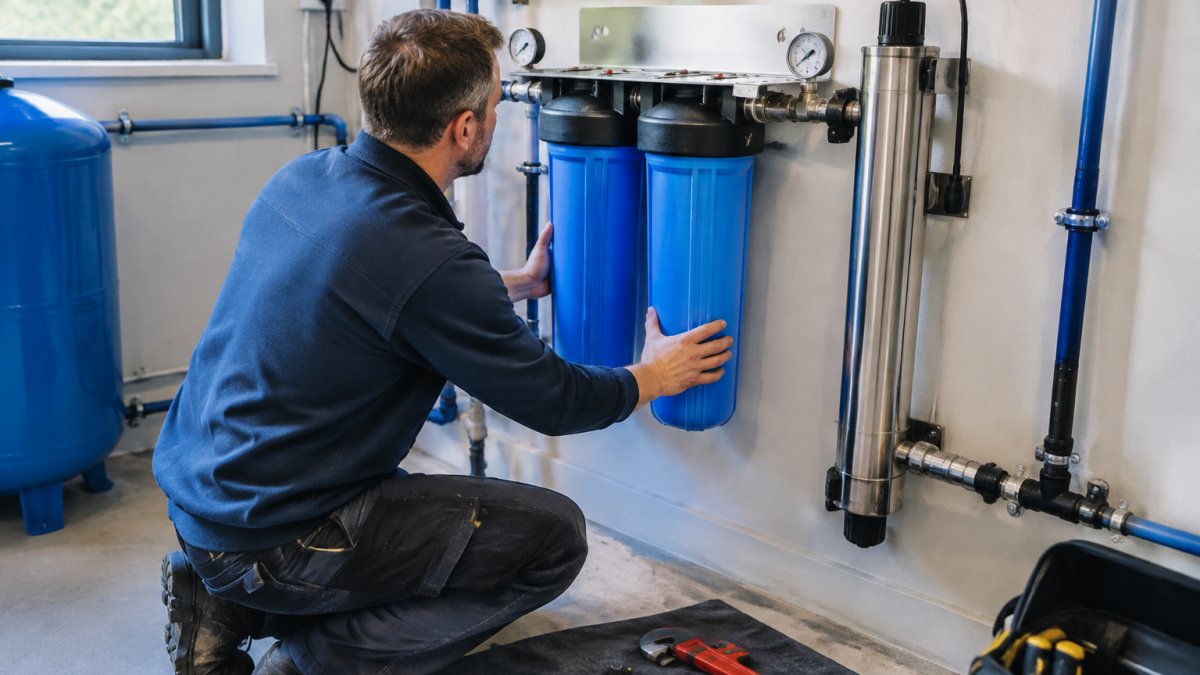
Installation follows a fixed sequence. Deviating from it causes most of the problems we hear about.
- Mount the bracket and housings level on a solid wall
- Fit cartridges and lubricate O-rings lightly
- Connect inlet and outlet, respecting flow direction arrows
- Install the UV reactor downstream of all filtration
- Open the supply slowly and bleed air from housings
- Check every joint for leaks under pressure
- Run water for several minutes to flush new cartridges
- Record the pressure gauge readings as your baseline
Commissioning Checks Before You Drink
Work through these before the water is used for drinking or cooking:
- Pressure drop across filters is within the expected range
- UV lamp is lit and the alarm circuit tests correctly
- Flow rate at the tap meets your household demand
If pressure drops sharply after installation, a cartridge is likely installed backwards or the housing is air-locked.
Failure Scenarios and Safe-Use Guidance
A bore water system is only safe while every stage is working. Plan for the moments when it is not.
- Power outage: the UV lamp goes out and water passing through is untreated. Fit a solenoid shut-off valve or treat the supply as non-potable until power returns and the lamp is confirmed lit.
- UV lamp failure or alarm activation: stop drinking the water. Replace the lamp, flush the line, and do not resume until the alarm clears and the lamp is confirmed operating.
- Cloudy or discoloured water: turbidity shields microorganisms from UV. Do not drink it; check sediment cartridges and retest before resuming.
Watch out: a UV lamp that still glows may be past its effective life. Replace it using the countdown expiry on the controller.
Flow Rate and Pressure Checks
Measure flow at the furthest tap, not at the plant room, because pipe runs and fixtures reduce pressure. Compare the result with the reactor's rated maximum flow at your validated dose.
Record baseline pressure readings at commissioning. A rising pressure drop across the sediment stages is the earliest sign a cartridge needs changing, and catching it early protects the UV stage downstream.
Bore Water Filter Maintenance and Seasonal Checks
Bore water filter maintenance matters: filters left too long clog, and a clogged filter starves the UV stage downstream.
A practical schedule:
- Monthly: glance at pressure gauges and note any rise
- Every 3 to 6 months: replace sediment cartridges, sooner if pressure climbs
- Annually: replace the UV lamp, even if it still glows
- After heavy rain: retest your bore, since surface contamination can shift quickly
UV lamps lose germicidal strength over time while still producing visible light. Replace on schedule, not on appearance.
Seasonal variability is real. Bore water quality can change after drought, flooding or heavy irrigation nearby. Retest annually and after any noticeable change in taste, colour or smell.
Choose Your Bore Water System at the Awesome Water Showroom
Getting bore water right comes down to three things: test first, match stages to results, and keep the maintenance up. The equipment is straightforward once the water is understood.
That is where we can help. Awesome Water® is a proudly Australian family-owned business operating since 2011, and we offer a range of water filtration products and accessories.
Visit our physical showroom in Sydney to see the systems in person. Explore the Showroom and find the right setup for your bore.
Bore water rarely behaves the same way twice, so the system you choose needs to match your actual test results rather than a generic template.
Frequently Asked Questions
Can bore water be filtered for drinking?
Yes, but filtration alone is only part of it. A bore water filtration setup usually combines sediment cartridges to catch dirt and rust, a carbon or resin stage for colour, odour and some dissolved metals, and UV treatment to disinfect bacteria and viruses. The right combination depends on what a laboratory test finds in your bore. Test first, then match the treatment stages to the results rather than buying a system and hoping it covers everything.
Does UV treatment make bore water safe to drink?
UV disinfection destroys harmful microorganisms, and the Viqua lamp in the Awesome Water twin 20-inch system is a high output 45 watt UV lamp. It does not remove chemicals, dissolved minerals, sediment or heavy metals, and cloudy water shields microorganisms from the light. That is why UV sits last in the chain, after sediment and carbon filtration have cleared the water and brought turbidity down.
What filters are needed before a UV system for bore water?
At minimum, a sediment pre-filter is used before the UV stage. The Awesome Water twin 20-inch UV system runs a 50-20 micron polyspun cartridge followed by a 20-1 micron cartridge, then the UV stage. If your test shows tannins, iron or heavy metals, add a carbon block or Aragon resin stage, as in the triple 20-inch whole-of-house system, and treat severe tannin problems before the water reaches the UV reactor.
How often should bore water filters and UV lamps be replaced?
Check pressure gauges for a drop, which signals when sediment cartridges need attention. UV lamps can lose germicidal strength while still glowing, so follow the manufacturer's replacement guidance. The Awesome Water UV system includes a countdown expiry and an electronic alarm for lamp failure.
