
Last Updated: November 2, 2026
Quick Summary
Choose office water filtration for tank and bore water by first testing the supply for microbiological, physical and chemical contaminants, then matching each treatment stage to a specific result. Tank water usually needs sediment filtration plus UV disinfection, while bore water often also needs iron removal, softening or carbon treatment, arranged in a sensible order.
- Test your water first, including total coliforms and E. coli, turbidity, iron, manganese and hardness.
- Turbidity above roughly 5 NTU calls for sediment filtration ahead of UV, as particles shield micro-organisms.
- Iron above about 0.3 mg/L or manganese above about 0.05 mg/L needs a dedicated removal stage.
- Put softening upstream of carbon and reverse osmosis to protect the membrane and cartridges from scale.
- Track pressure gauges and replace cartridges when a blockage shows, as timing depends on water quality and use.
Table of Contents
- Why Tank and Bore Water Need Different Office Filtration
- Test Your Water Before Choosing a Filter
- Matching Filtration to Contaminants in Tank Water
- Treating Bore Water: Iron, Hardness and Bore-Specific Contaminants
- When a Commercial Reverse Osmosis Water Filter Makes Sense
- Sizing, Installation and Ongoing Costs for a Workplace System
- Booking Your Water Test and Showroom Visit
- Frequently Asked Questions
Tank and bore water can look clear and still carry bacteria, sediment, iron or hardness that you would not want in a staff kitchen. Choosing office water filtration for tank and bore water is different from choosing a filter for mains supply, because the source varies so much from property to property. This guide from Awesome Water® explains how to test your water, match filtration to what is actually in it, and size a system for a workplace.
Why Tank and Bore Water Need Different Office Filtration
Tank and bore water are not treated by a water authority before they reach your tap. Mains water is treated and monitored at the source, but a tank collects whatever falls on the roof, and a bore draws from groundwater that can carry minerals, iron and biological material.
Our view is that a single generic filter rarely suits both. You can compare the UV tank and bore system for this treatment step to see what it covers.

Test Your Water Before Choosing a Filter
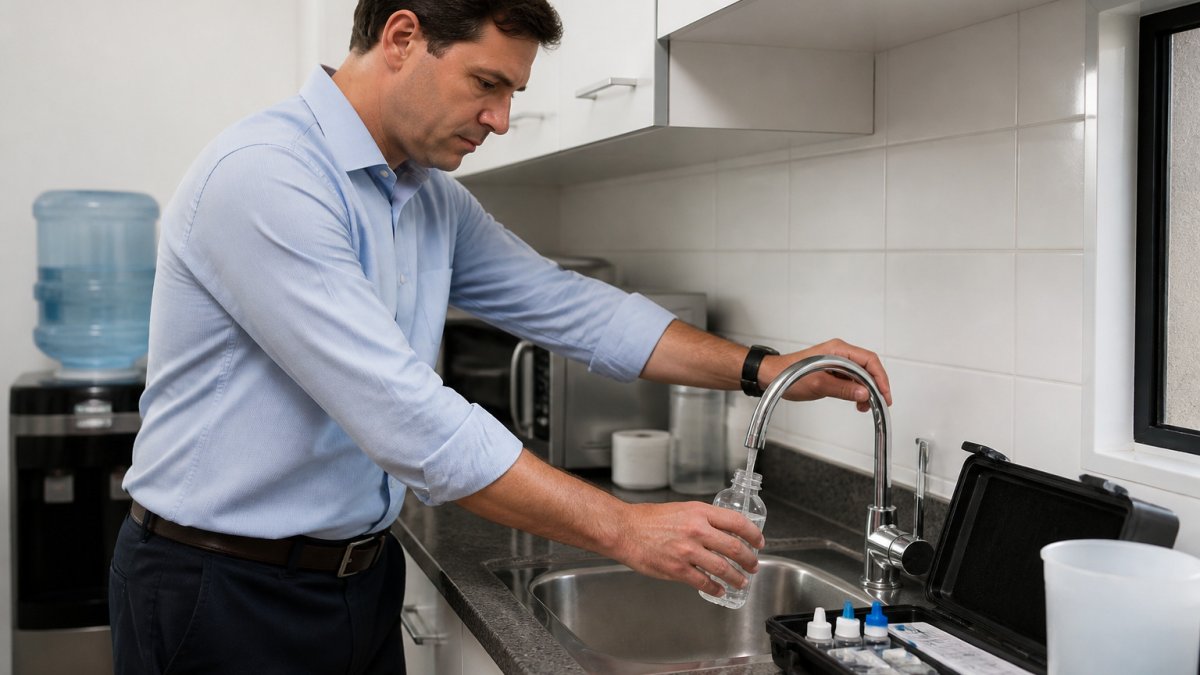
Testing is the step most buyers skip, and it is the one that tells you what to buy. Without a test, you are guessing at contaminants, and guessing leads either to over-specifying an expensive system or under-specifying one that fails within months. A laboratory test gives you a baseline to compare against after installation and a record for workplace health and safety files.
What to test for
A practical office panel for tank and bore water should cover three groups:
- Microbiological: total coliforms, E. coli and, where the lab offers it, heterotrophic plate count. These tell you whether disinfection is needed and whether the source is faecally contaminated.
- Physical: turbidity, pH, colour and suspended solids. Turbidity matters twice over, it indicates sediment load and it shields micro-organisms from UV, so a UV stage downstream of a turbid supply will underperform.
- Chemical: iron, manganese, hardness (as calcium carbonate), nitrate, salinity or total dissolved solids (TDS), and any locally relevant parameter such as fluoride or arsenic where the geology suggests it. For tank water, also ask about pesticides and herbicides if the roof catchment is near agricultural land.
How to collect a sample that stands up
Use the laboratory's own sterile container and follow its instructions exactly, a sample decanted into a household jar will not give a valid microbiological result. For a bore, run the tap for several minutes before sampling to clear the standing volume in the pipework; for a tank, sample from the tap fed by the tank rather than dipping a container into the tank itself. Keep the sample cool and deliver it promptly, because bacterial counts shift with time and temperature.
Turning results into a treatment plan
Read the results as a decision tree rather than a scorecard:
- Coliforms or E. coli present → disinfection is not optional. Plan UV as a final barrier and consider chlorination or another residual disinfectant if storage or distribution is long.
- Turbidity above roughly 5 NTU → add or upsize sediment filtration ahead of UV, because particles protect micro-organisms from ultraviolet light.
- Iron above about 0.3 mg/L or manganese above about 0.05 mg/L → plan an oxidation and media or resin stage; these levels are the point at which staining and taste become noticeable.
- Hardness above roughly 200 mg/L as calcium carbonate → scale will form on kettles, urns and any downstream membrane, so a softening or scale-control stage earns its place.
- TDS or salinity elevated → reverse osmosis becomes worth costing, because sediment and carbon stages will not reduce dissolved salts.
These figures are common trigger points, not legal limits; your laboratory will report results against the relevant Australian drinking water guideline values, and those are the numbers to discuss with your supplier. The point is that each result should point to a specific stage, not to a generic 'multi-stage system'.
Australian Drinking Water Guidelines
Matching Filtration to Contaminants in Tank Water
Tank water usually carries organic matter, sediment and animal droppings from the roof. The contaminants you need to address depend on your catchment and tank maintenance.
Sediment, rust and suspended solids
A sediment pre-filter removes grit, rust flakes and suspended particles before they reach finer stages. The Triple 20" system uses a 20-1 micron polyspun filter for this job, which also helps prevent blockages further down the line. Sediment filtration does not kill bacteria, so it should never be the only stage on tank water.
Microbiological safety and disinfection
Bacteria and other micro-organisms are the main reason tank water needs more than a basic filter. Carbon and sediment filters do not reliably remove them. UV disinfection inactivates micro-organisms without adding chemicals, and our Twin 20" UV system is designed for this purpose. Confirm with your test results that disinfection is needed, and keep the UV lamp and any alarm functioning.
Treating Bore Water: Iron, Hardness and Bore-Specific Contaminants
Bore water often differs from tank water, and it differs from bore to bore. Groundwater picks up whatever the surrounding geology holds, so two properties a few kilometres apart can need completely different treatment. That variability is why a bore test matters more than a tank test, and why a treatment train should be built stage by stage rather than bought as a fixed package.
Awesome Water® - Triple - 20" - WOH Filtration - Tank & Bore Water System →
Iron and manganese: dissolved versus oxidised
The distinction that decides the treatment is whether the iron is dissolved (ferrous) or already oxidised (ferric). Dissolved iron is clear when it leaves the tap and turns cloudy or rusty after standing as it meets oxygen. Oxidised iron arrives as visible rust particles.
- Oxidised iron and manganese are a filtration problem: a sediment stage, often rated to 1 micron or finer, will capture the particles.
- Dissolved iron and manganese pass straight through a sediment filter. They need oxidation first, by aeration, chlorination or an oxidising medium, followed by filtration of the resulting particles, or a resin designed to remove them. A resin-based stage such as Aragon is intended for this job, removing hardness salts and dissolved iron alongside a carbon block for taste and odour.
Iron above roughly 0.3 mg/L and manganese above roughly 0.05 mg/L are the levels at which staining, metallic taste and laundry marking typically appear. Above those, plan a dedicated iron stage rather than hoping a carbon block will cope.
Hardness and scale
Hardness is dissolved calcium and magnesium, measured as calcium carbonate. It does not affect health at typical levels, but it scales kettles, urns, coffee machines and any downstream membrane, and scale shortens the life of every stage behind it. Selecting the appropriate filtration technology requires balancing these maintenance demands against your specific water quality needs, a decision process detailed in our analysis of reverse osmosis vs carbon.
Salinity, TDS and nitrate
Some bores carry elevated salinity or TDS, and some carry nitrate from agricultural land use. Neither is removed by sediment, carbon or softening resin. High TDS or nitrate results are best discussed with your laboratory and water treatment specialist, as they fall outside the scope of the systems described here. Nitrate in particular should be discussed with your laboratory and supplier, because it has a guideline value and because treatment must be sized to the concentration found.
Other locally variable parameters
Depending on the geology, a bore may also show elevated fluoride, arsenic or other naturally occurring elements. These are not universal, which is exactly why testing comes before equipment selection. A supplier who recommends a bore system without seeing a water analysis is guessing.
Putting the stages in order
A common bore treatment train runs: sediment pre-filter → iron and manganese removal → softening → carbon → disinfection → reverse osmosis only if dissolved salts require it. Each stage protects the next, and putting them in the wrong order, carbon before iron removal, for example, means the carbon fouls with iron and fails early. Confirm the sequence with your supplier against your actual test results rather than copying a package specification.
When a Commercial Reverse Osmosis Water Filter Makes Sense
Compare the cost of a reverse osmosis stage against what your test results actually require. In many cases a sediment, carbon and disinfection combination meets the need at lower cost. Reverse osmosis makes more sense when the water analysis points to dissolved contaminants that other stages cannot handle.
Sizing, Installation and Ongoing Costs for a Workplace System
Size the system to your daily demand, including staff numbers, kitchen use and visitor use.
Installation usually means plumbing into the tank or bore supply line with a stainless bracket and the fittings included. Our guide on when to replace your water filter cartridge explains the signs to watch for.
Prices for the Awesome Water® tank and bore systems are: Triple 20" WOH system AUD 1,388.00, Twin 20" WOH system AUD 799.00, Twin 10" WOH system AUD 699.00 and Twin 20" UV system AUD 1,999.00.
Booking Your Water Test and Showroom Visit
A test result is the best starting point for choosing a system, and it is worth reviewing before you buy. If you want to see the equipment in person, you can visit our Sydney showroom to view tank and bore systems. For office-specific needs, our guide on choosing a filter for staff drinking water covers the practical trade-offs. When you are ready to plan upkeep, our guide on how to sanitise a water cooler sets out the steps that sit alongside your filtration.

Frequently Asked Questions
What water filter is best for tank water in an office?
For tank water in an office, start with a whole-of-house sediment and carbon system before the water reaches staff taps. Awesome Water® sells a Twin 20" Tank and Bore Water system at AUD 799.00 that combines a 20-1 micron polyspun sediment filter with an Aragon filter, and a Triple 20" system at AUD 1,388.00 adds a carbon block stage for stronger tannin and odour problems. Choose based on your test results rather than price alone, and confirm the flow rate suits your peak office demand.
Should tank or bore water be tested before choosing a filter?
Yes. Tank and bore water vary widely between sites, and the contaminants present decide which filter stages you need. A test for bacteria, turbidity, iron, hardness, pH and tannins shows whether you need sediment removal, carbon, disinfection or a reverse osmosis stage. Buying a filter without testing risks paying for stages you do not need while missing the problem that actually matters, such as microbial contamination.
Can office water filters treat bore water?
Many can, but only if the system targets bore water's usual problems. Bore water often carries dissolved iron, hardness salts and fine sediment that can stain fixtures and clog cartridges. Awesome Water®'s tank and bore water systems include a polyspun sediment stage and an Aragon filter that removes hardness salts, dissolved and colloidal iron and heavy metals through ion-exchange resin. Confirm the system's flow rate and pressure against your site before purchase.
How often should filters for tank or bore water be replaced?
Replacement intervals depend on the water source and the volume used, so there is no single schedule. Sediment cartridges usually block first on bore water with high solids, so check the glycerol pressure gauges regularly. A pressure drop across a stage is the clearest sign it needs changing. Keep a service log so you can adjust intervals to your own water quality over time.
