

When you're looking for the best water filter for microplastics, you need a system that can reliably trap particles smaller than 5 microns. Right now, the two heavy hitters for this job are reverse osmosis (RO) and high-quality carbon block filters. These technologies work by creating a physical barrier so fine that those tiny plastic fragments simply can't get through.
The Invisible Plastic Problem in Your Water
The water coming out of your tap might look crystal clear, but it could be hiding an unwelcome guest: microplastics. Imagine them as a kind of microscopic glitter. Once these tiny plastic bits get into the water supply, they’re notoriously difficult to get out, and they can end up in the water you and your family drink every day.
This isn't some far-off environmental issue; it's a reality right here in Australian homes. Everyday items we all use—plastic bottles, shopping bags, and even the fibres from synthetic clothing—are constantly breaking down. Sunlight, friction, and water wear away at larger plastic waste, turning it into fragments smaller than 5 millimetres. From there, it’s an easy path into our rivers, reservoirs, and eventually, our taps.
A Widespread Contaminant
The sheer scale of plastic pollution is staggering, and it has a direct impact on our water sources. National monitoring has found that every square kilometre of Australian sea surface water contains around 4,000 pieces of microplastics. This problem is fed by an estimated 130,000 tonnes of plastic leaking into our marine environment every single year.
Because this contamination is so widespread, standard water treatment plants often struggle to catch everything. While these municipal systems are great at removing larger debris and killing off nasty bacteria, most weren't designed to filter out contaminants on a microscopic scale.
This is why effective home water filtration is no longer a luxury—it’s a practical and necessary step for any modern household. Taking control of your water quality at the tap gives you peace of mind and an essential layer of defence for your family's health.
It's also worth remembering that microplastics can sneak into our bodies from other surprising places. For instance, learning about the unseen risks of microplastics from plastic cutting boards shows just how pervasive these particles are in our daily lives, making a good water filter even more important. You can also read our detailed guide to learn more about how these particles find their way into our water supply: https://www.awesomewater.com/blogs/awesome-water/microplastics-in-water.
Ultimately, installing a specialised filter is one of the most direct and reliable ways to tackle this invisible threat. It empowers you to make sure the water your loved ones drink is as pure and safe as possible, free from the plastic fragments that have unfortunately become part of our modern environment.
How Filtration Technologies Capture Microplastics
So, how do water filters actually catch something as tiny as a microplastic?
Think of a simple kitchen sieve. When you pour sandy water through it, the water rushes out, but the larger sand grains get left behind. Water filters operate on the exact same principle, just on a microscopic level.
The secret to a filter's power lies in its micron rating. This number tells you the size of the pores in the filter material. The smaller the micron rating, the tinier the particles it can block. Since most microplastics are bigger than one micron, a filter with a low enough rating acts as a physical barrier, effectively sieving them out of your drinking water.
This simple idea—physical removal—is the basis for several incredibly effective filtration methods. Each one just uses this principle in a slightly different way to get the job done.
This diagram shows how plastic pollution in our environment breaks down into smaller and smaller pieces that eventually find their way into our tap water.
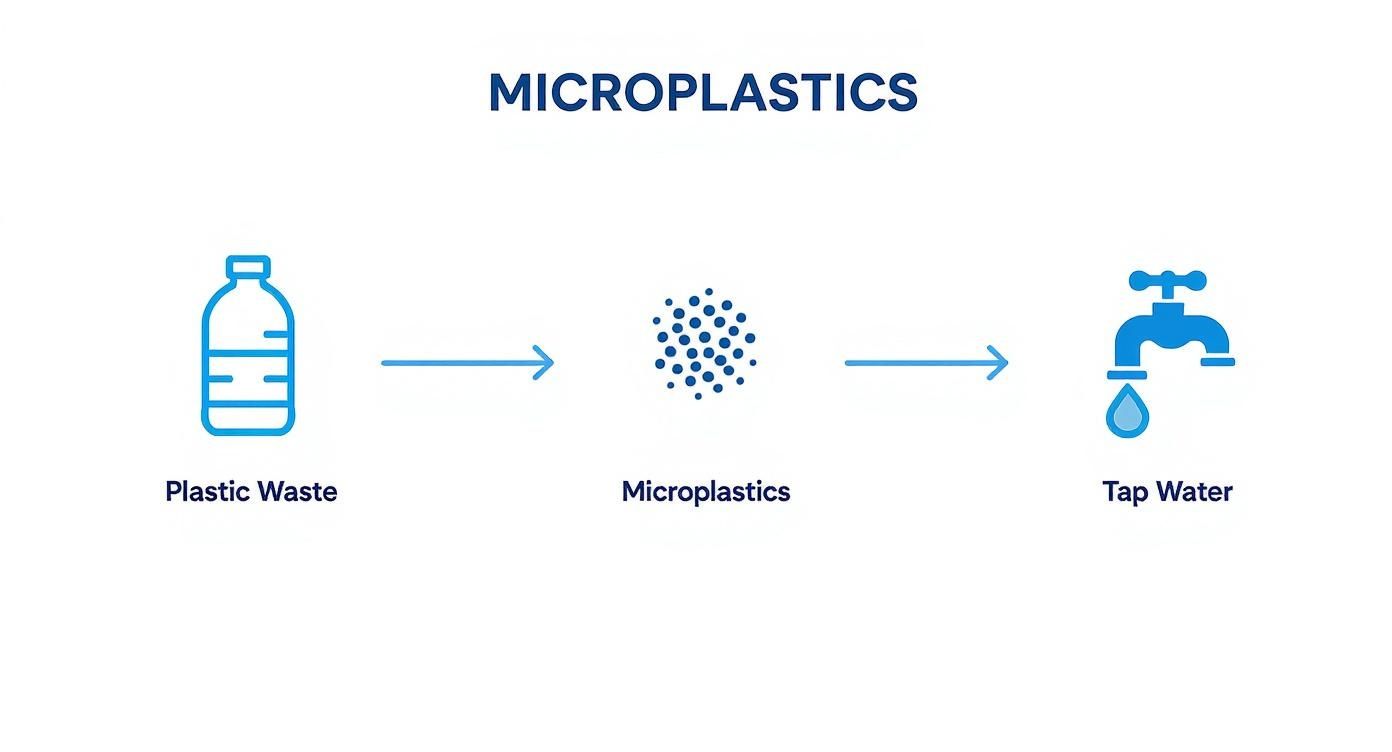
It’s a stark reminder of the direct line between large-scale plastic waste and the contamination of the water we rely on every day, making effective, at-home filtration more important than ever.
The Role of Activated Carbon Filters
One of the most common technologies you'll come across is the activated carbon filter. These filters use a solid block of highly porous carbon to trap contaminants. Imagine a sponge, but with millions of microscopic tunnels and crevices running through it.
As water flows through this carbon block, two things happen. First, larger particles like sediment and a good portion of microplastics get physically blocked, unable to squeeze through the dense material. At the same time, a process called adsorption takes place, where chemical contaminants like chlorine actually stick to the carbon's surface, which is what improves your water's taste and smell.
When it comes to stopping microplastics, the density of the carbon block is key. A quality carbon block filter with a rating of 1 micron or less serves as a fantastic first line of defence, capable of capturing a huge number of these plastic particles. You can learn more about how carbon filters work their magic in our detailed guide.
Ultrafiltration: A Finer Level of Protection
Moving up the ladder in filtration strength, we get to ultrafiltration (UF). UF systems use a special hollow fibre membrane that has even smaller pores, typically between 0.01 and 0.1 microns. This makes them incredibly good at removing not only microplastics but also much tinier nasties like bacteria and viruses.
The UF membrane essentially acts like a super-fine net. Water is forced through, but nearly all suspended solids and microscopic particles are left behind. It’s a brilliant method for physical particle removal, though it won't remove dissolved substances like salts or minerals.
Reverse Osmosis: The Gold Standard for Purity
If you’re looking for the ultimate in water purification, reverse osmosis (RO) is the most complete solution available. An RO system is hands-down the best water filter for microplastics because it targets particles on an almost molecular level.
This technology uses high pressure to force water through a semi-permeable membrane with unbelievably small pores—around 0.0001 microns in size.
The process is so rigorous that it strips out almost everything that isn't a pure water molecule.
- Microplastics and Nanoplastics: The membrane's pores are far too tiny for even the smallest plastic fragments to get through.
- Dissolved Contaminants: It effectively removes heavy metals, fluoride, salts, and a wide range of chemicals.
- Viruses and Bacteria: These are easily blocked by the RO membrane, ensuring your water is microbiologically safe.
Think of an RO membrane as a high-security checkpoint for your water, only allowing pure H₂O molecules to pass while rejecting a long list of unwanted contaminants. Because it’s so thorough, reverse osmosis is widely seen as the gold standard for cleaning up the full spectrum of potential pollutants in tap water. Of course, home filters are just one piece of the puzzle; broader environmental efforts include revolutionising smart water technology in waste water management to tackle pollution right at the source.
Comparing Microplastic Filtration Technologies
To make sense of it all, it helps to see these technologies side-by-side. Each has its strengths, and the right choice often depends on your specific water quality concerns and budget.
| Technology | Mechanism | Effectiveness on Microplastics | Removes Nanoplastics? | Best For |
|---|---|---|---|---|
| Activated Carbon | Physical filtration and adsorption. Pores trap particles. | Good (especially carbon blocks ≤1 micron) | No | Improving taste, removing chlorine, and capturing larger microplastics. |
| Ultrafiltration (UF) | A fine membrane acts as a physical barrier. | Excellent | Limited (may capture some) | Removing bacteria, viruses, and a wide range of microplastics without stripping minerals. |
| Reverse Osmosis (RO) | High pressure forces water through a near-impermeable membrane. | Exceptional | Yes | Ultimate purity, removing the full spectrum of contaminants including nanoplastics and dissolved solids. |
Ultimately, whether you choose a robust carbon filter, an ultrafiltration system, or the comprehensive power of reverse osmosis, you're taking a vital step towards ensuring the water you drink is clean, safe, and free from plastic contamination.
Understanding Certifications and Performance Claims
Walking down the water filter aisle can feel pretty overwhelming. You’re faced with a wall of boxes plastered in confusing codes and technical jargon. So, how can you tell the difference between genuine performance and just clever marketing?
The secret is to look for independent certifications. Think of them as a trusted, third-party referee that verifies a filter actually does what the box says it will. These aren’t just arbitrary stamps of approval; they’re based on rigorous standards developed by public health organisations to make sure these products are safe and effective. It’s like a food safety rating for a restaurant—it gives you an unbiased measure of quality you can trust.
Decoding NSF/ANSI Standards
In the world of water filtration, the most recognised name is the NSF (National Sanitation Foundation). When a filter is NSF/ANSI certified, it means it has survived a battery of tough tests to meet very specific performance goals. For tackling microplastics, two standards are especially important.
-
NSF/ANSI 42 - Aesthetic Effects: This one covers contaminants that mess with the taste, smell, and look of your water, like chlorine and other particulates. It basically confirms the filter makes your water more pleasant to drink.
-
NSF/ANSI 53 - Health Effects: This is the big one for any contaminant that could pose a health risk. Filters certified to this standard have been proven to reduce specific nasties like lead, mercury, and certain parasites.
The key thing is that both of these standards include a rating for particulate reduction. This is where you’ll find the proof that a filter can handle tiny particles like microplastics.
Look for Particulate Reduction Class I
When you're hunting for a filter to remove microplastics, the most critical phrase you want to see is "Particulate Reduction, Class I." This specific certification, which falls under both NSF/ANSI 42 and 53, verifies that a filter can remove at least 85% of particles in the 0.5 to 1.0 micron size range.
Why is this so important? Because the vast majority of microplastics floating around in tap water fall squarely into this size category. A filter that meets the Class I standard has proven its ability to physically block and trap these tiny invaders. Without this certification, any claim about "microplastic reduction" is just marketing noise.
This standard gives you a clear, verifiable benchmark. It cuts through the vague promises and gets down to concrete, lab-tested performance, giving you real confidence that your filter is up to the job.
Another vital certification to check for, especially here in Australia, is the WaterMark. This is a mandatory certification that ensures any plumbing product is safe, fit for purpose, and meets our national standards. To get the full story, check out this guide on why WaterMark is important for water filters.
Moving Beyond the Marketing Hype
Not all filters are created equal, and packaging can be seriously misleading. Some brands might say their product "helps reduce" certain things without offering any certified data to back it up. Vague statements like that are often a red flag.
To make a truly informed choice, always put filters with specific, certified performance data at the top of your list. Look for a performance data sheet—you can usually find it on the manufacturer's website. This document will detail exactly what the filter has been tested to remove and at what percentage.
This data sheet is your best tool for comparing different models based on hard evidence, not flashy ads. By focusing on verified certifications like NSF/ANSI 53 and "Particulate Reduction, Class I," you can confidently pick the best water filter that delivers proven protection against microplastics.
Choosing the Right Filter System for Your Home
Alright, you've got a solid grasp of how filters work and what those certifications mean. Now for the practical part: finding the right setup for your home. The best water filter for microplastics isn't a one-size-fits-all solution; it's about what works for your lifestyle, budget, and living situation. Let's walk through the options you'll find here in Australia.
Every system strikes a different balance between convenience, upfront cost, and sheer filtering power. From a simple pitcher on the benchtop to a system that guards your entire home, there’s a reliable choice to get your family cleaner, safer drinking water.
Water Filter Pitchers
For many people, a water filter pitcher is the first step into home filtration. They’re affordable, require absolutely no installation, and are a perfect match for renters or anyone with limited space. Just fill it up from the tap, pop it in the fridge, and let gravity do the rest.
But that convenience does come with a few trade-offs. The filtration muscle of pitchers can vary wildly. While many basic models are just for improving taste and smell, some higher-end pitchers use dense carbon block filters that are surprisingly effective against larger microplastics. The key is to check for certifications like NSF/ANSI 53 for Particulate Reduction Class I.
- Pros: Low initial cost, portable, and zero installation headaches.
- Cons: Small capacity, filters water slowly, and not as powerful as other systems. Plus, the cost of frequent cartridge changes can add up.
Tap-Mounted Filters
Looking for a bit more convenience? A tap-mounted filter could be the answer. These little units attach straight onto your kitchen tap, letting you flick a switch for instant filtered water. Best of all, installation is usually a simple DIY job that won’t leave any permanent marks on your plumbing.
Tap-mounted filters give you a continuous flow of clean water, which is a big upgrade from waiting for a pitcher to fill. Their effectiveness, like pitchers, comes down to the quality of the filter cartridge inside. Look for multi-stage carbon block options to get solid protection against many microplastic particles.
Under-Sink Filtration Systems
If you want serious filtration power that stays completely out of sight, an under-sink system is a fantastic choice. These are plumbed directly into your cold water line, feeding a separate, dedicated tap on your sink for purified water. This means a constant, on-demand supply without any clutter on your benchtop.
This is where you start to see a much wider range of technologies, from powerful multi-stage carbon block filters all the way up to reverse osmosis (RO). An under-sink RO system is really the gold standard for your kitchen, capable of removing not just microplastics but also tiny nanoplastics, heavy metals, fluoride, and other tricky dissolved contaminants.
While they do require a bit more effort to install and a higher initial investment, under-sink systems deliver far superior performance. Their long-term cost per litre is also much lower than pitchers, making them a serious commitment to top-tier water quality where you need it most.
Whole-House Filtration Systems
For the ultimate peace of mind, a whole-house (or 'point-of-entry') system filters every single drop of water entering your home. It's installed right where your main water line comes in, which means every tap—from the kitchen to the bathroom sink and even the shower—delivers purified water.
This is the most comprehensive solution you can get. It reduces your family's exposure to contaminants not just from drinking water but also from bathing and washing. These systems are also great for protecting your home's plumbing and appliances from sediment that can cause blockages and damage. If you want to learn more about setting up a fortress against a wider range of contaminants, you can discover how to remove PFAS, microplastics, and fluoride with whole-house water filtration.
The upfront cost and need for professional installation make this the biggest investment, but for homeowners who want to leave no stone unturned, it’s a complete barrier against unwanted particles.
Which Water Filter Type Is Right for You?
So, how do you choose? It really comes down to weighing the cost, installation, and filtration power against what your household actually needs. This table breaks it down to help you find your perfect match.
| Filter Type | Typical Cost | Installation | Microplastic Removal | Ideal Household |
|---|---|---|---|---|
| Pitcher | $30 - $80 | None | Fair to Good | Renters, students, or as a low-cost starting point. |
| Tap-Mounted | $50 - $150 | DIY, simple | Good | Renters or anyone wanting on-demand filtered water without plumbing changes. |
| Under-Sink | $250 - $800+ | DIY or Professional | Excellent to Exceptional | Homeowners or long-term renters wanting high-performance kitchen water. |
| Whole-House | $1,000 - $4,000+ | Professional | Excellent | Homeowners seeking comprehensive protection for the entire property. |
Ultimately, the goal is to find a system that you'll use consistently. Whether you start small with a pitcher or go all-in with a whole-house system, taking action is the most important step towards cleaner, healthier water.
Maintaining Your Filter For Lasting Protection
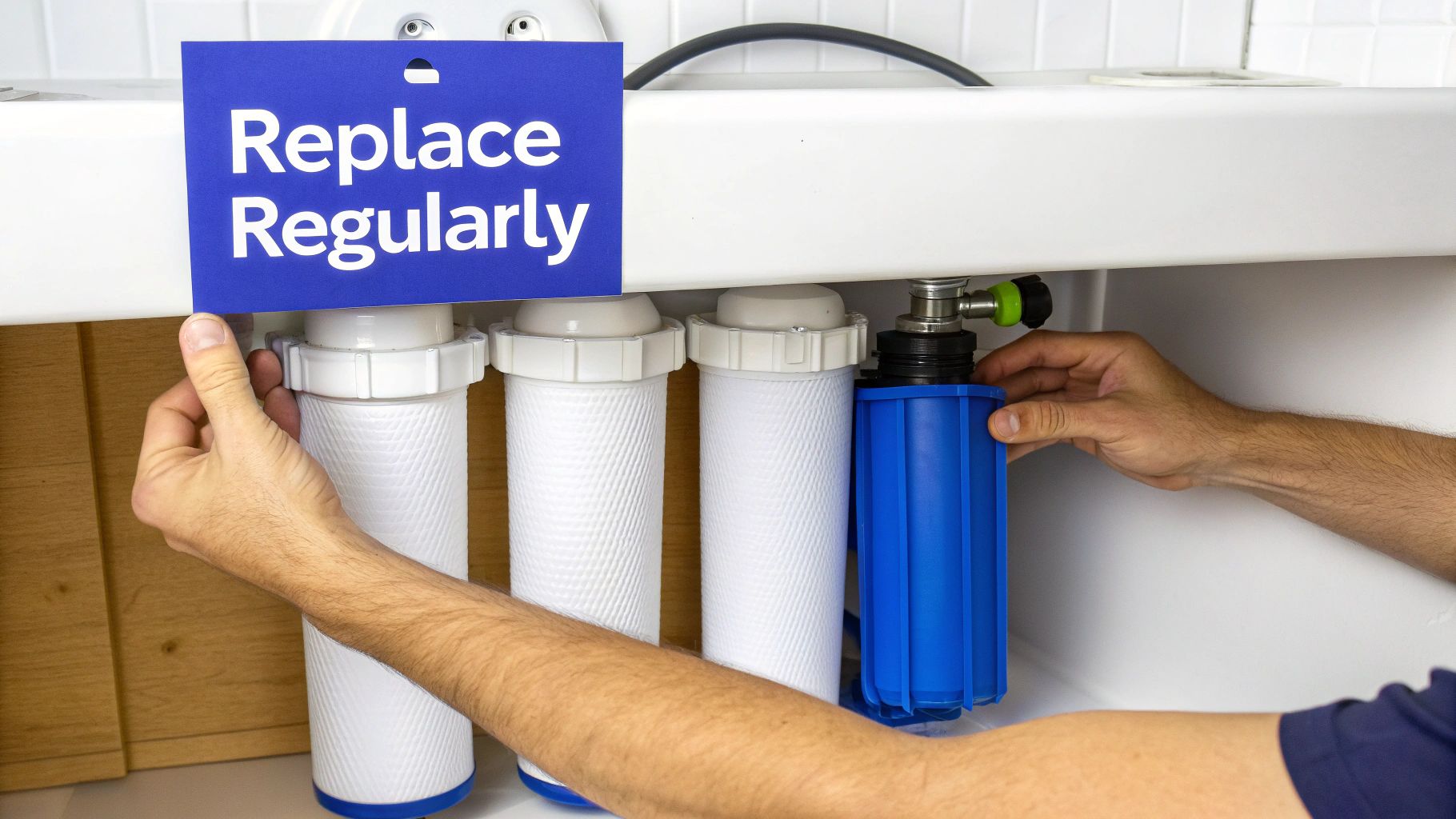
Choosing the right water filter is a huge first step, but its long-term performance comes down to one simple thing: consistent maintenance. A water filter isn't a "set and forget" appliance. Think of it like the oil filter in your car—it works hard trapping all the gunk, but eventually, it gets full and needs replacing to keep the engine running smoothly.
Your filter cartridge is no different. Over time, its pores get clogged with the microplastics, sediment, and other contaminants it has successfully pulled from your water. Once it hits its limit, its effectiveness drops off a cliff. Not only can it no longer trap new particles, but a neglected filter can even become a breeding ground for bacteria.
This is why sticking to a replacement schedule is non-negotiable for safe, clean drinking water. An old, saturated cartridge won’t just stop working; it could potentially make your water quality worse than it was without any filter at all.
Know Your Replacement Timelines
Each filter technology has a different lifespan, usually measured in months or the total litres of water it has processed. It's always best to follow the manufacturer's specific guidelines, but here’s a general idea of what to expect from different systems.
- Activated Carbon Cartridges: You'll find these in everything from water jugs to tap-mounted units and under-sink systems. They typically need to be replaced every 3 to 6 months, depending on how much water your household uses.
- Reverse Osmosis (RO) Membranes: The powerful RO membrane is the core of the system and is built to last. You can generally expect it to work effectively for 2 to 4 years before it needs a change.
- Pre- and Post-Filters: Most RO and whole-house systems also have sediment and carbon pre-filters that act as bodyguards for the main membrane. These usually need replacing every 6 to 12 months.
Keeping up with these changes is the single most important thing you can do to guarantee your system continues to deliver the protection you paid for. For more detailed tips, you can learn how to maintain a water filter to prolong its life and make sure it’s always running at its best.
Following a regular maintenance schedule isn't just about performance—it's about ensuring your water remains consistently safe. Budgeting for replacement cartridges as part of the total cost of ownership ensures you're prepared to keep your system in peak condition from day one.
At the end of the day, your water filter is a powerful shield against contamination. By committing to its simple, ongoing upkeep, you ensure that this shield never falters, providing your family with pure, microplastic-free water for years to come.
Your Guide to Making an Informed Decision
Let's cut through the noise. Picking the right water filter can feel overwhelming, but it really comes down to a few key things. Once you know what to look for, you can confidently choose a system that keeps your family’s drinking water safe and clean.
It all starts with the micron rating. Think of this number as the single most important clue to how well a filter can physically block those tiny plastic bits. For microplastics, you need to be looking for filters rated at 1 micron or smaller. Anything bigger just won't cut it.
The Shortlist for Choosing Your Filter
When you’re ready to buy, this simple checklist will help you ignore the marketing hype and focus on what actually delivers results.
- Go for a Low Micron Rating: Don't settle for vague claims. Look for a specific number. A filter with a Particulate Reduction, Class I certification has been properly tested to capture particles down to 0.5 microns—a fantastic benchmark.
- Consider Reverse Osmosis (RO) for Total Protection: If you want the absolute highest level of purification, nothing beats a reverse osmosis system. Its membrane is incredibly fine (around 0.0001 microns), meaning it strips out virtually everything, including the smallest microplastics and even nanoplastics.
- Check for Real Certifications: Don't just take a company's word for it. Independent certifications like NSF/ANSI 53 are your guarantee that the filter does what it says it does. It's undeniable proof of performance.
At the end of the day, knowledge is your best tool. When you understand what these ratings and certifications mean, you can invest in a filter that provides a genuine, verifiable shield against plastic pollution. That's real peace of mind.
Beyond the Tap: The Bigger Picture
Choosing a great water filter is a powerful move for your health, but it’s also part of a much larger story. Every time you fill a glass from your filtered tap, you’re preventing another plastic bottle from entering our environment. It’s a small, personal choice with a massive ripple effect.
And there is good news. A recent CSIRO research study found that plastic pollution on Aussie coastlines has dropped by an incredible 39 per cent over the last decade. That’s a huge win, but the fight isn't over. Flexible plastics, like those from food packaging, still make up three-quarters of all rubbish found on our beaches.
By fitting your home with the best water filter for microplastics, you’re making a smart choice—not just for your family, but for the health of our planet, too.
Of course. Here is the rewritten section, adopting the expert, natural, and human-like voice from the provided examples.
Your Top Questions Answered
When you start digging into water filtration, it's natural for questions to pop up. We get it. Below, we've tackled some of the most common queries we hear from Aussie families who are worried about microplastics in their drinking water.
Getting the right info is the first step to making a smart choice for your family's health.
Does Boiling Water Get Rid of Microplastics?
No, unfortunately, boiling your water won’t do a thing to remove microplastics. While bringing water to a boil is a great way to kill off nasty biological bugs like bacteria and viruses, it has zero effect on physical particles like tiny plastic fragments.
In fact, you might even make the problem slightly worse. As the water boils, some of it turns to steam, leaving the microplastics behind in a smaller volume of water. This actually increases their concentration. To physically get these particles out, you need a proper filter that can trap them.
Is Bottled Water a Safer, Microplastic-Free Option?
You'd think so, but surprisingly, the answer is no. Study after study has shown that bottled water often contains far higher levels of microplastics than the water coming out of your tap. It makes sense when you think about it—tiny plastic bits can break away from the bottle itself and the cap, especially during the bottling process.
This is exactly why filtering your own tap water is a much more reliable (and sustainable) way to go. You take back control of your water quality and dramatically cut down on single-use plastic waste at the same time. It’s a win-win.
How Can I Know if My Tap Water Has Microplastics?
This is a tricky one. Right now, Australian water authorities aren't required to test for or report on microplastic levels in our public water supply. While studies across the country have confirmed that they are present pretty much everywhere, there isn't a big public database you can check for your specific suburb.
Given how widespread plastic pollution is and how easily these tiny particles move through the water cycle, it's safest to just assume your tap water contains some level of microplastic contamination. The most effective move you can make is to be proactive and install a certified water filter to ensure your drinking water is as clean as possible.
Ready to protect your family’s water from microplastics? Awesome Water® offers a full range of certified filtration systems built for Australian homes. Whether you need a powerful under-sink unit or a handy benchtop purifier, we'll help you find the perfect solution for clean, great-tasting water. Check out the collection at https://www.awesomewater.com.