

Thinking about getting a water purifier that removes fluoride? The short answer is yes—there are some seriously effective options out there. This guide is here to cut through the noise and give you clear, practical answers to help you find the right system for your home.
Your Path to Fluoride-Free Water at Home
Choosing to filter fluoride from your tap water is a personal decision, often driven by health considerations or simply a preference for how your water tastes. For a lot of Aussies, the first step is just figuring out which purifiers can actually do the job.
Think of this guide as your complete roadmap. We'll start with the basics and build your knowledge from the ground up, exploring why households decide to remove fluoride in the first place and diving into the specific technologies that make it happen.
What We'll Cover in This Guide
To help you make a confident choice, we're going to walk through several key areas. It's a step-by-step journey to finding the perfect solution for your needs.
We'll focus on:
- Filtration Technologies That Actually Work: We’ll compare methods like reverse osmosis and activated alumina, explaining exactly how each one targets and removes fluoride.
- System Types for Your Home: We'll break down the differences between benchtop, under-sink, and whole-house systems to see which one fits your lifestyle best.
- The Australian Context: All our advice is tailored for local water conditions and standards, so you know it's relevant and practical for you.
Here in Australia, community water fluoridation is pretty standard, with about 90% of the population getting treated tap water. Household filters vary wildly in their effectiveness—your standard carbon filter won’t touch it, but technologies like reverse osmosis (RO) can remove up to 98% of fluoride.
Given that Aussie water authorities aim for fluoride levels between 0.6–1.1 mg/L, a high-quality RO system can make a massive difference. That’s a fact supported by the National Health and Medical Research Council (NHMRC).
By the end of this guide, you’ll have the know-how to pick the right water purifier, ensuring your home’s water meets your exact standards. And if you're looking for a complete home solution, you can also learn how to remove PFAS, microplastics, and fluoride with whole-house water filtration.
Why Is Fluoride in Australian Tap Water Anyway?
Before we jump into choosing the right water purifier that removes fluoride, it’s worth taking a moment to understand why it’s in most Australian taps in the first place. Fluoride isn't some accidental contaminant; its presence is a deliberate, long-standing public health decision.
For decades, Australian states and territories have practised community water fluoridation. You can think of it like fortifying milk with Vitamin D or bread with folic acid—it's a nationwide strategy aimed at boosting the dental health of the whole population by strengthening tooth enamel and preventing decay.
This isn’t a random process. Health bodies like the National Health and Medical Research Council (NHMRC) set very specific targets for fluoride levels to ensure they are consistent, safe, and effective. It's a method backed by a mountain of research, all pointing to a community-wide health benefit.
A Public Health Initiative With Two Sides
The number one reason for adding fluoride to our drinking water is to tackle dental cavities, which are a common and expensive health problem. By delivering a low, steady dose of fluoride through the tap, the initiative helps protect everyone's teeth from the acid produced by bacteria, making them tougher and more resistant to decay.
This strategy has been a cornerstone of Australian dental policy for a long time. Of course, not everyone sees it the same way. While many people support it for its proven dental benefits, a growing number of people prefer to have full control over their fluoride intake for personal health reasons. This is exactly why the demand for fluoride-specific water purifiers has grown.
If you're curious about the different perspectives, we dive deeper into the debate in our article on the effects of water fluoridation and whether it is good for you. Understanding both sides helps paint a clearer picture, acknowledging the official public health logic while respecting your right to choose what's in your water at home.
The Science Behind the Strategy
The results of this public health program speak for themselves. National reviews used by Australian health authorities show that water fluoridation slashes tooth decay rates by 26% to 44% in children, teenagers, and adults. That's a huge reduction, and it’s why the policy has remained in place for so long across most of the country.
With around 90% of Australians receiving fluoridated water, this widespread initiative has a massive impact on our national dental health. The tension between this system-wide benefit and personal choice is precisely what drives the market for fluoride removal systems.
This background explains why official guidance and consumer interest sometimes seem at odds. While health authorities maintain that it’s unnecessary to remove fluoride from properly treated water, they also recognise that certain home filters—like reverse osmosis systems—are incredibly effective at doing just so.
Ultimately, the choice is yours. By understanding why fluoride is there to begin with, you're in a much better position to decide if a water purifier that removes fluoride is the right move for your home and family.
How Different Filters Remove Fluoride
If you’re on the hunt for a water purifier that removes fluoride, you need to know a crucial fact: not all filters are created equal. Far from it. Those standard jug filters with simple activated carbon? They’re great for making your water taste better by tackling chlorine, but when it comes to fluoride, they’re completely out of their depth.
To really get a handle on fluoride, you need specialised technology.
Think of it like trying to catch fish. A wide net (your basic carbon filter) might snag the big, slow ones, but the tiny, quick ones—like fluoride ions—will swim right through. For fluoride, you need a much finer, purpose-built net. Let's dive into the powerful filtration methods that are actually up to the task.
The diagram below shows how water fluoridation works as a public health measure, aiming to reduce tooth decay across the population.
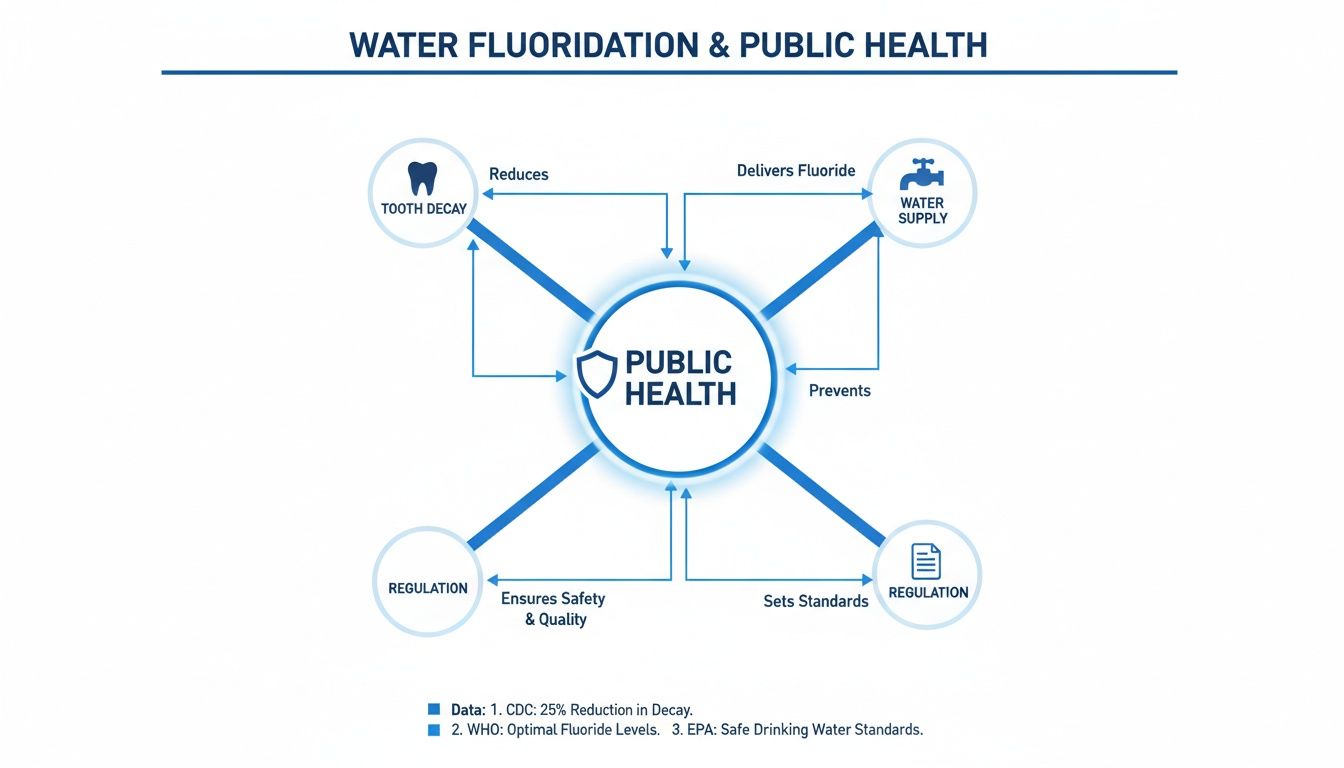
This systematic approach is precisely why specialised home filtration is necessary if you choose to take control and remove fluoride from your own drinking water.
Reverse Osmosis: The Purity Gatekeeper
When it comes to fluoride removal, Reverse Osmosis (RO) is widely seen as the gold standard. It’s not uncommon for RO systems to achieve incredible removal rates of 90–98%. This isn't just filtering; it's a process that fundamentally separates pure water from almost everything else dissolved in it.
Picture a high-security checkpoint just for water molecules. An RO system uses pressure to push tap water through a semi-permeable membrane—a barrier with pores so microscopic that only H₂O molecules can squeeze through.
Things like fluoride, lead, arsenic, and salts are simply too large to pass. They get left behind and are flushed away in a stream of wastewater, leaving you with exceptionally pure drinking water on the other side.
Because RO is so thorough, it also strips out beneficial minerals like calcium and magnesium. That's why many quality RO systems now include a remineralisation stage. This final step adds those healthy minerals back into the water, giving you the best of both worlds: ultimate purity without losing essential nutrients.
To get a better sense of how different technologies stack up, have a look at our comprehensive guide on how to remove fluoride from water.
Activated Alumina: The Fluoride Magnet
Another heavy hitter in the world of fluoride removal is Activated Alumina. This technology uses a highly porous form of aluminium oxide that has a natural knack for attracting fluoride, arsenic, and selenium. The secret is a process called adsorption.
Imagine the filter media as a surface covered in tiny magnets specifically calibrated to grab onto fluoride ions. As water flows through, fluoride particles "stick" to the surface of the alumina granules, effectively pulling them out of the water.
This method is seriously effective, capable of removing up to 90% of fluoride. Its performance, however, is closely tied to the water's pH. It works best in slightly acidic water (around pH 5.5) and loses some of its punch as the water becomes more alkaline.
Bone Char: A Natural Adsorbent
Believe it or not, Bone Char filtration is one of the oldest water purification methods around, and it's still a reliable choice for targeting fluoride. It’s made from charred animal bones, creating a carbon-based material rich in a substance called hydroxyapatite, which is fantastic at adsorbing fluoride.
Much like Activated Alumina, bone char works by attracting fluoride ions to its vast, porous surface. It’s a completely natural and proven way to reduce fluoride, often removing up to 90% from drinking water.
While its name might sound a bit old-fashioned, bone char is a time-tested filtration medium that’s valued for its natural composition and solid performance.
Distillation: The Ultimate Purification Process
Water Distillation mimics the earth's own water cycle—evaporation and condensation—to produce incredibly pure water. A distiller boils water, turning it into steam. As the steam rises, it leaves behind nearly all contaminants, including fluoride, heavy metals, bacteria, and minerals.
This pure water vapour is then collected in a separate chamber where it cools and condenses back into liquid. The result? Water that is almost 100% free of impurities.
Beyond home units, advanced lab water purifiers for distilled water use this same principle to achieve the highest levels of purity. While distillation is extremely effective, home distillers tend to be slow, consume a lot of energy, and only produce small batches. For a busy household, they’re often less practical than on-demand systems like Reverse Osmosis.
Comparing Fluoride Removal Technologies
With several strong options available, choosing the right one depends on your specific needs, budget, and desired level of purity. The table below breaks down the key differences to help you decide.
| Technology | Typical Fluoride Removal Rate | Pros | Cons |
|---|---|---|---|
| Reverse Osmosis (RO) | 90–98% | Extremely high removal rate for a wide range of contaminants. Provides exceptionally pure water. | Wastes some water in the process; may remove beneficial minerals (unless remineralised); requires plumbing installation. |
| Activated Alumina | Up to 90% | Highly effective at targeting fluoride, arsenic, and selenium. Good filter lifespan. | Effectiveness depends on water pH; can be slow; media needs periodic replacement. |
| Bone Char | Up to 90% | Natural and sustainable filtration media. Also effective for removing heavy metals and chlorine. | Can be more expensive than other media; performance can vary based on water chemistry. |
| Distillation | Up to 99%+ | Removes nearly all contaminants, producing the purest form of water. | Very slow process; high energy consumption; produces water in batches, not on demand. |
Ultimately, whether you lean towards the comprehensive power of Reverse Osmosis or the targeted approach of Activated Alumina, you have effective solutions at your disposal to achieve the water quality you want for your home.
Alright, you've got the science down on how to get fluoride out of your water. Now for the fun part: picking the right piece of gear that actually fits into your daily life. Because let's be honest, the best filtration technology in the world is useless if it's a hassle to use.
Choosing a water purifier that removes fluoride is about more than just the filter inside. It’s about matching the system's design to your home, your family's needs, and how you live. We're moving from the 'how it works' to the 'which one is for me'.
Think of this as a matchmaking service for your kitchen. We’ll look at the most common setups in Australia—benchtop, under-sink, and whole-house systems—and figure out which one is your perfect partner for pure, fluoride-free water.
Benchtop Water Purifiers
If you’re after convenience and simplicity, benchtop water purifiers are your best friend. These units sit right on your kitchen counter, and the best part? Minimal to zero installation. They are the perfect solution for renters or anyone who doesn't want to mess with their plumbing.
Most benchtop models are self-contained. Some are gravity-fed (you just pour water in the top), while others connect to your tap with a simple diverter valve. Their biggest win is portability and ease of use. But a word of caution: if you're serious about fluoride removal, you need to choose wisely. While many basic benchtop units use simple carbon filters, the ones you want will have specialised media like activated alumina to specifically target fluoride. They’re a fantastic choice for singles, couples, or small families with everyday water needs.
Under-Sink Water Purifiers
Looking for something more permanent and powerful? An under-sink water purifier is usually the way to go. These systems are tucked neatly away in your kitchen cabinet, connected directly to the cold water line. You get beautifully purified water from a dedicated, stylish tap right on your sink, keeping your benchtops completely clear.
This is the most popular setup for reverse osmosis (RO) systems, which are the undisputed champions of fluoride removal. The multi-stage filters and storage tank that make RO so effective are perfectly suited for an under-sink installation. They produce a high volume of incredibly pure water on demand, making them ideal for larger families or anyone who gets through a lot of filtered water for drinking and cooking.
The demand for these advanced home systems is growing. The Australian water purifier market is projected to expand at a compound annual growth rate (CAGR) of about 6.8% over the next decade. This growth is driven by consumer interest in high-performance filtration like RO, which manufacturers often advertise with 95–98% fluoride reduction rates. Discover more insights about this market trend at expertmarketresearch.com.au.
This trend shows a clear shift. More and more Aussies want systems that give them total control over their water quality right at the tap.
Whole-House Water Purifiers
A whole-house water filter, sometimes called a point-of-entry (POE) system, is the ultimate all-in-one solution. It’s installed where the main water line enters your property, treating every single drop of water you use—from the kitchen sink and dishwasher to your showers and laundry.
While this sounds amazing, tackling fluoride on this scale gets complicated and costly. A whole-house system powerful enough to remove fluoride typically needs massive tanks filled with activated alumina media and requires professional plumbing work. Reverse osmosis just isn't practical for a whole house due to the sheer amount of wastewater it produces and the drop in water pressure it causes.
For most families, a targeted under-sink system for drinking and cooking water is a much smarter, more cost-effective way to get rid of fluoride where it matters most.
Which System Is Right for You?
So, how do you choose? It all comes down to your priorities. To help you decide, think about these key points:
- Kitchen Space: If you value a clear benchtop, an under-sink system is the obvious choice. It keeps everything hidden away and your kitchen looking sleek.
- Installation: Benchtop units are a breeze—you can set them up yourself in minutes. Under-sink and whole-house systems are more involved and often need a professional touch.
- Water Output: A big family that loves to cook will appreciate the high, on-demand flow of an under-sink RO system. A single person or a couple will likely find a benchtop unit is more than enough.
- Budget: Benchtop purifiers usually have the lowest upfront cost. Whole-house systems are the biggest investment. Under-sink systems sit comfortably in the middle, offering fantastic long-term value.
By thinking about how you use water every day, you can confidently pick a purifier that not only removes fluoride effectively but also fits seamlessly into your home and lifestyle.
Understanding the True Cost of Ownership
Choosing a water purifier to remove fluoride isn't just a one-off purchase; it's a long-term investment in your family's health. To make a smart choice that you’ll be happy with for years to come, you need to look past the initial price tag and understand the true, ongoing cost of ownership.
This means factoring in the upfront cost of the unit itself, any potential installation fees, and of course, the regular expense of replacement filters. A cheaper system might look like a bargain at first, but if its filters are pricey or need changing every few months, it could end up costing you a lot more in the long run.
Breaking Down the Costs
Let’s get into the key expenses you’ll come across. Thinking about these factors will help you budget properly and avoid any nasty surprises down the track.
- Initial Unit Price: This is the most obvious cost, and it can range from under a hundred dollars for a basic benchtop model to several thousand for a full-blown whole-house system.
- Installation Fees: Many benchtop units are simple DIY jobs, but under-sink systems often need a professional touch. A licensed plumber might charge anywhere from $150 to $400, depending on how complex your setup is.
- Replacement Filters: This is where the real ongoing cost lies. The price and lifespan of filters vary wildly between different models and technologies.
A quality reverse osmosis system, for instance, has several filter stages that need replacing at different times—some every six months, others only once a year. If you don't replace them on schedule, you're not just compromising your water quality; you could actually damage the system's sensitive membrane.
The real value of a water purifier isn't just its initial price. It's in its ability to deliver consistently pure water, affordably, over many years. Budgeting for regular filter replacements is the key to making sure your system always performs at its best.
Getting a handle on the timing and cost of these changes is crucial. To help you stay prepared, you can check out our detailed guide to plan for your water filter replacement schedule.
Hypothetical 5-Year Cost Breakdown
To make this crystal clear, let's map out a hypothetical cost breakdown for a typical under-sink reverse osmosis (RO) system—a very popular choice for fluoride removal.
| Cost Component | Year 1 | Year 2 | Year 3 | Year 4 | Year 5 | Total Cost |
|---|---|---|---|---|---|---|
| Upfront Unit Cost | $450 | - | - | - | - | $450 |
| Installation Fee | $250 | - | - | - | - | $250 |
| Annual Filter Set | $120 | $120 | $120 | $120 | $120 | $600 |
| RO Membrane (Replaced Yr 3) | - | - | $90 | - | - | $90 |
| Total Annual Cost | $820 | $120 | $210 | $120 | $120 | $1,390 |
As you can see, after that first year's investment, the ongoing cost becomes pretty manageable. In this example, it averages out to around $188 per year for filters. This kind of transparent view helps you properly compare different systems and choose a water purifier that removes fluoride without breaking your budget down the line. Simple maintenance, like sanitising the system when you change the filters, will also help extend its life and keep it running perfectly.
Your Smart Buyer's Checklist for Fluoride Purifiers

Feeling ready to choose? Let's boil everything down into a simple, practical shopping companion. You can use this guide to confidently compare different models and make sure you pick the perfect water purifier that removes fluoride for your Aussie home.
It's easy to get lost in all the options, but zeroing in on these key points will guarantee you make a smart investment. Think of this as your final quality check before you commit.
Filtration Technology and Performance
First things first—and this is the most critical step—you need to confirm the core technology. Does the system actually use a method proven to be effective against fluoride?
- Primary Technology: Check that the purifier uses Reverse Osmosis (RO), Activated Alumina, or Bone Char. These are the heavy hitters when it comes to significant fluoride reduction. A standard carbon filter just won't cut it for this job.
- Removal Rate: Look for independent, third-party test results that spell out the fluoride removal percentage. A quality system should be removing at least 90% of fluoride. Don't fall for vague claims; always ask to see the performance data sheet.
Your goal here is confidence. A reputable brand will be totally upfront about its technology and provide clear, verifiable data on its fluoride removal capabilities. Anything less should be a major red flag.
System Suitability and Long-Term Costs
Next up, let's make sure the purifier actually fits your lifestyle and budget, not just for today but for years down the track.
- Match the System to Your Home: Think about whether a convenient benchtop model, a hidden under-sink unit, or a comprehensive whole-house system is the best fit. Consider your space, family size, and how much installation you're comfortable with.
- Calculate Total Cost of Ownership: It's easy to just look at the initial price tag, but you need to think bigger. Factor in the cost and lifespan of all the replacement filters and membranes to understand the true long-term expense.
- Review the Warranty and Support: Check the warranty period for both the system and its parts. You’ll also want to confirm that Australian-based customer support is available to help out with any installation or maintenance questions you might have later on.
Got Questions About Fluoride Water Filters? We’ve Got Answers.
When you’re diving into the world of water purifiers that remove fluoride, it’s completely normal to have a few questions pop up. Getting clear, straightforward answers is the final step to feeling confident you’re making the right choice for your family. Let's tackle some of the most common queries we hear.
A big one we get all the time is about those popular filter jugs. People often ask, "Do brands like Brita remove fluoride?" The short and simple answer is no. The standard activated carbon filters you find in most supermarket jugs do a great job of making your water taste better by reducing chlorine, but they aren't designed to capture tiny fluoride ions. To do that, you need specialised filter technology like reverse osmosis or activated alumina.
Does Reverse Osmosis Also Remove Healthy Minerals?
This is a fantastic and very important question. Because reverse osmosis (RO) is so incredibly thorough, its super-fine membrane doesn't just stop fluoride and contaminants; it also removes beneficial minerals like calcium and magnesium.
But that's not a deal-breaker. In fact, many high-quality RO systems have a clever solution: they include a remineralisation filter as the final stage. This special cartridge adds a healthy, balanced mix of essential minerals back into the water just before it reaches your glass. So you really get the best of both worlds—pure water free from nasties like fluoride, but still full of the healthy minerals your body needs.
How Can I Be Sure the Fluoride Is Actually Gone?
Once you’ve got your new purifier set up, you’ll naturally want proof that it’s doing its job. "How can I be certain the fluoride has been removed?" is a perfectly fair question. While sending a sample to a professional lab gives you the most precise results, it can get a bit pricey.
For some peace of mind at home, you could try an at-home water testing kit. You can find electronic fluoride meters or specialised testing strips online. These tools let you measure the fluoride levels in your tap water and then compare it to your newly purified water, giving you a clear picture of your system's performance.
Ready to enjoy pure, great-tasting water free from fluoride and other contaminants? Explore the range of advanced filtration solutions at Awesome Water® and find the perfect system for your home today.