

When you think about a top-tier water filter for hard water, you might just be thinking about better-tasting drinks. But the real value is in protecting your home’s appliances and plumbing from the slow, steady damage of mineral buildup. The best approach is usually a whole-house system that tackles the problem right at the source, stopping scale before it ever gets a chance to form.
The Hidden Costs of Hard Water in Your Home
It usually starts with little things you can’t quite put your finger on. Maybe it’s that chalky film on your glass shower door that never seems to go away, or the stubborn spots on your dishes, no matter how much you rinse them. Ever looked inside your kettle and seen that stubborn layer of white scale? Those are the classic calling cards of hard water, a familiar headache for countless Aussie households.
But these small frustrations are really just the tip of the iceberg. Hard water can make your laundry feel stiff and scratchy, leave your skin feeling tight and dry, and turn your hair dull and lifeless. The culprit is surprisingly simple: hard water is just water with a high concentration of dissolved minerals, mainly calcium and magnesium.
The Unseen Damage to Your Home
While the visible signs of hard water are annoying, the invisible damage is where the real costs lie. Those minerals build up inside your pipes and appliances, forming a rock-hard deposit we call limescale. This buildup forces your hot water system, dishwasher, and coffee machine to work much harder just to function, leading to higher energy bills and, eventually, premature failure.
What starts as a minor inconvenience can quickly turn into a major expense. You can get a clearer picture of potential expenses by exploring our guide on whole house water filtration costs.
This guide will give you a clear path to understanding your home's water supply. We'll walk through the best treatment options and help you find the right water filter for hard water to protect your investments and make daily life a little bit easier.
Protecting Your Fixtures and Appliances
Beyond the big-ticket appliances, hard water takes a toll on your bathroom's appearance and the lifespan of its components. Taps, showerheads, and tiles can become coated in an unsightly scale that’s a real chore to remove. When you're thinking about bathroom upgrades, understanding selecting durable bathroom fixtures can help you choose materials that better resist mineral buildup.
Choosing the right filtration system is your first line of defence. It doesn't just solve the immediate cosmetic issues; it provides long-term protection for every part of your home that uses water. It’s a proactive approach that ensures your appliances run efficiently and your home looks its best for years to come.
So, What Exactly Is Hard Water? Let's Break It Down
Think of your water’s long journey to get to your tap. As it travels through layers of rock and soil, it acts like a natural sponge, picking up minerals along the way. When it soaks up a high amount of calcium and magnesium, it becomes what we call hard water.
Now, these minerals aren't harmful to drink—in fact, they're essential nutrients. The problem is, they're the root cause of some seriously frustrating and costly issues around the house. We're talking about more than just a cloudy glass of water; hard water affects everything from your expensive appliances to your daily cleaning routine.
The main villain here is limescale. When hard water gets heated, those dissolved minerals drop out and form a chalky, rock-hard deposit. This buildup quietly creeps into your home's pipes and appliances, acting a bit like cholesterol in your plumbing’s arteries.
The Silent Damage to Your Appliances
Your hot water system, dishwasher, kettle, and coffee machine are prime targets. Limescale loves to coat their internal heating elements, forcing them to work much harder and burn more energy just to do their job. This constant strain leads to lower efficiency, more frequent breakdowns, and a much shorter lifespan for the appliances you depend on.
Take your coffee machine, for example. As scale builds up, it struggles to hold a consistent temperature, which messes with the flavour of your morning brew. Eventually, that scale can clog the machine's delicate internal pipes, causing leaks or complete failure. A quality water filter for hard water is your best defence against this slow, creeping destruction.
The consequences of this mineral assault are clear and costly:
- Higher Energy Bills: Your appliances have to fight through layers of scale to heat water.
- Costly Repairs: Components give out under the constant strain of mineral deposits.
- Premature Replacements: That dishwasher that should last a decade might only make it a few years.
Frustrating Aesthetic Issues
Beyond the mechanical damage, hard water leaves its chalky signature all over your home. It reacts with soaps and detergents to create a sticky film known as soap scum—the culprit behind that stubborn haze on your shower screens, tiles, and bathtubs.
You'll also notice it in your personal care routine. The minerals in hard water stop soap and shampoo from lathering properly, leaving a residue on your skin and hair. This often leads to dry, itchy skin and hair that feels dull, brittle, and impossible to manage.
The constant battle against soap scum, cloudy glassware, and stiff laundry isn't just a cleaning headache. It's a direct symptom of what’s in your water. The only way to win this fight for good is to solve the water problem at the source.
Hard Water Across Australia
Not all tap water in Australia is created equal. Water hardness varies massively from one region to another, depending on whether the supply comes from surface water (like dams) or mineral-rich groundwater.
Perth’s water sources, for instance, are notoriously hard, with measurements often ranging from 145 mg/L to over 200 mg/L. Sydney, on the other hand, has much softer water, typically measuring around 57 mg/L. You can even review Perth's annual drinking water quality report to see the data for yourself.
This regional difference is why a one-size-fits-all approach just doesn't cut it. The mineral content also impacts your water's overall chemical balance, which is another key factor. If you're curious, you can learn more in our detailed guide on understanding water pH levels. Knowing your local water quality is the first and most important step toward choosing the right solution for your home.
Comparing Hard Water Treatment Technologies
Trying to find the right solution for hard water can be a bit of a headache. The main source of confusion? Not all "water filters" actually do anything about hardness. Many filters are brilliant at removing things like chlorine and sediment, making your water taste better, but they leave the troublemaking minerals—calcium and magnesium—right where they are. This is the key difference between filtering and softening.
Getting your head around this is the first big step. Filtering is about taste and purity. Softening or conditioning is specifically about tackling the minerals that cause that crusty, white limescale.
Let’s break down the most common technologies available to Australian homeowners to see what they actually do and which problem each one solves.
Ion-Exchange Water Softeners: The Classic Solution
When most people think of a hard water solution, this is what comes to mind. Ion-exchange water softeners are the undisputed champions when it comes to physically removing hardness minerals from your entire water supply.
Here’s how it works: your water flows through a tank filled with tiny resin beads that are coated with sodium (salt) ions. As the hard water passes over them, a clever swap happens. The resin grabs hold of the calcium and magnesium ions and releases the sodium ions into the water. This process, known as ion exchange, leaves you with genuinely soft water flowing through your home.
- Primary Benefit: It’s the only technology that completely removes the minerals causing hardness, putting a stop to limescale buildup in your pipes and on your appliances.
- Key Drawback: These systems use a brine tank that you need to top up with salt pellets regularly, which is an ongoing cost and a bit of a maintenance job.
For total protection of everything from your hot water system to your shower screen, this is hands down the most effective route.
Salt-Free Water Conditioners: A Different Approach
If you're after a low-maintenance alternative, salt-free water conditioners are a pretty compelling option. The crucial thing to understand here is that these systems do not soften water in the traditional sense; they condition it to stop scale from forming.
The most popular type uses a technology called Template-Assisted Crystallisation (TAC). Instead of swapping out the hardness minerals, TAC systems use special media to change their structure, turning them into microscopic crystals. These tiny, stable crystals can't stick to surfaces, so they simply flow through your plumbing without causing any limescale dramas.
You can think of it like this: calcium and magnesium are like sticky notes. A traditional softener removes the notes completely. A TAC conditioner just curls up the sticky corners so the notes can't attach to anything as they float by.
This means you get the main benefit—scale prevention—without needing salt, electricity, or regeneration cycles that waste water. Your water still has its mineral content, so you won't get that "slippery" feeling of soft water, but your pipes and appliances are safe from damaging buildup.
Reverse Osmosis: The Purity Specialist
While softeners and conditioners treat your whole house, Reverse Osmosis (RO) systems are the specialists. They focus on delivering incredibly pure water to a single tap, usually in your kitchen. This technology is less about softening and more about total purification.
An RO system works by pushing water through a semi-permeable membrane with microscopic pores. This membrane is like a bouncer at a club—it blocks not only hardness minerals like calcium and magnesium but also a huge list of other unwanted contaminants.
When your main goal is pristine drinking water, it's a powerful water filter for hard water. It can strip out:
- Up to 99% of dissolved salts and minerals
- Heavy metals like lead and arsenic
- Chlorine and fluoride
- Bacteria and viruses
The result is water of exceptional purity, perfect for drinking, cooking, and making ice that’s crystal clear. Because it removes the minerals, it also gets rid of that "hard" taste some people can't stand. If you want the absolute best quality drinking water on tap, you can explore the benefits of Awesome Water® reverse osmosis systems and see what a difference they make.
Keep in mind, though, that RO isn't a whole-house fix. It produces pure water quite slowly and creates wastewater during the process, making it impractical for treating all the water you use for showering, laundry, and flushing toilets.
Hard Water Treatment Technology Comparison
To make things even clearer, let's put these technologies side-by-side. Each has its place, and the best one for you really depends on what you're trying to achieve.
| Treatment Method | How It Works | Primary Benefit | Key Drawback |
|---|---|---|---|
| Ion-Exchange Softener | Swaps hardness minerals for sodium ions using resin beads. | Completely removes limescale-causing minerals for whole-home protection. | Requires regular salt refills and a regeneration cycle that uses water. |
| Salt-Free Conditioner (TAC) | Converts minerals into microscopic crystals that won't stick to surfaces. | Prevents scale buildup with virtually no maintenance. | Doesn't remove minerals, so water isn't technically "soft." |
| Reverse Osmosis (RO) | Forces water through an ultra-fine membrane to remove nearly all contaminants. | Delivers exceptionally pure, great-tasting drinking water at the tap. | Not a whole-house solution; produces wastewater and removes healthy minerals. |
As you can see, there's a clear distinction: ion-exchange removes, conditioners prevent, and reverse osmosis purifies. Understanding this difference is the key to choosing a system that will actually solve your hard water problems.
How to Choose the Right Hard Water Solution
Now that we've covered the different technologies, you’re ready to pick the perfect fit for your home. Choosing the right water filter for hard water isn’t about buying the most powerful or expensive system you can find; it’s about matching a solution to your specific situation.
Making the right call involves weighing up a few key factors. By stepping through them one by one, you can confidently zero in on a system that works for your family, your budget, and the scale of your hard water problem.
Start with Your Water Hardness Level
First things first: you need to find out just how hard your water actually is. A vague feeling that you have "hard water" isn't enough to make a smart decision. You need cold, hard data.
- Council Water Reports: Most local councils across Australia publish annual water quality reports. These are a great starting point and will give you a solid idea of the hardness level in your area, usually measured in milligrams per litre (mg/L) of calcium carbonate.
- DIY Test Kits: For a more immediate and precise reading, you can grab an inexpensive water hardness test kit from a hardware store. These simple strips or drops give you a reliable measurement in just a few minutes.
Once you have your number, you can see where you land. Water with over 120 mg/L is generally considered hard, while anything over 180 mg/L is classed as very hard and will likely need a serious treatment solution. To get the best results, it's worth exploring the various home water treatment solutions available that do more than just basic filtering.
Assess Your Household's Needs and Size
Your daily water usage is a huge piece of the puzzle. Think about how many people live in your home and what your water consumption habits look like.
A big family of five is going to put a lot more strain on a system than a couple living in a small flat. A whole-house ion-exchange softener, for instance, has to be sized correctly to handle your peak water flow without causing a drop in pressure and to make sure it isn't running regeneration cycles too often.
An undersized system will constantly struggle to keep up, giving you patchy results and potentially causing damage. On the flip side, an oversized system is just an unnecessary hit to your wallet, both upfront and in ongoing costs.
This simple decision tree can help you visualise whether you’re trying to protect the whole house or just make your drinking water better.
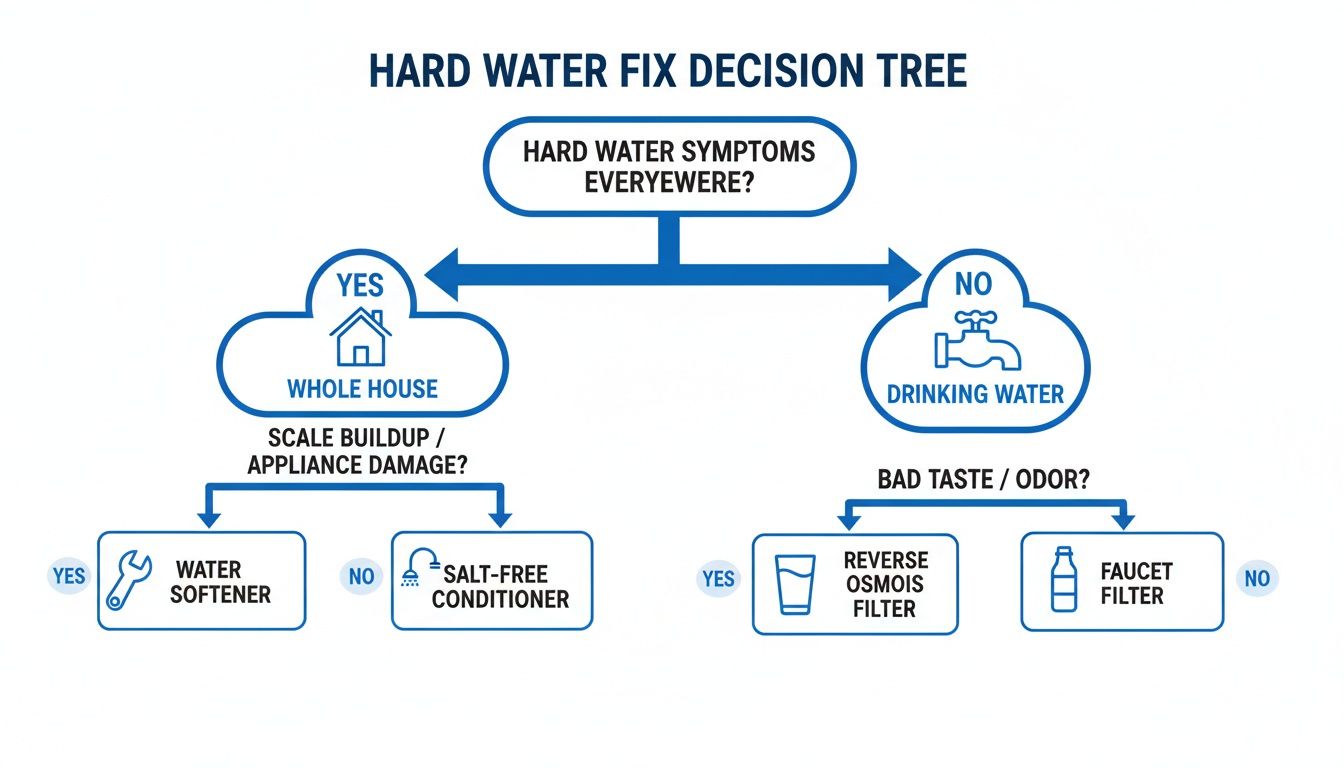
As you can see, there are two main paths: tackling appliance damage and scale everywhere, or just focusing on the quality of the water you drink.
Balance Budget, Space and Maintenance
Finally, the practical stuff will help narrow down your choice. It's crucial to look at the total cost of owning the system, not just the price tag on the box.
- Upfront Cost vs Long-Term Maintenance: An ion-exchange water softener might have a higher initial cost, and you'll have the ongoing expense of salt. A salt-free conditioner can cost more to buy but has almost no running costs. Point-of-use systems like reverse osmosis filters are much cheaper initially but need regular filter changes.
- Physical Space and Plumbing: Do you actually have a spot near your main water line for a big whole-house system? These units need a decent amount of room and access to a drain. Point-of-use systems are much more compact. If space is tight, you can learn about the benefits of Awesome under-sink filtration systems and see if one is right for you.
- Whole-House vs Point-of-Use: This is the big question. If your main goal is to stop limescale from wrecking your hot water system, dishwasher, and showerheads, a whole-house system is the only real answer. It treats every single drop of water that comes into your home. But if you’re only worried about the taste of your drinking water and your morning coffee, a point-of-use (POU) filter at the kitchen sink is a smart, targeted, and affordable fix.
Matching Awesome Water Filters to Your Needs
Knowing the technology is one thing, but figuring out how it solves your day-to-day frustrations is what really counts. This is where we connect the dots between your hard water headaches and the practical, effective solutions from Awesome Water®, designed for the real challenges Aussie households face.
Whether you're battling the notoriously hard water in your area or you’re simply fed up with chalky, chemical-tasting tap water, the right fix comes down to what you’re trying to achieve. Let's walk through two common scenarios to see how different products tackle very different problems.
For Pristine Drinking Water and Better Taste
Picture this: you live in a Melbourne apartment. Scale buildup isn't a massive disaster, but you just can't stand the chemical tang of your tap water. Your morning coffee tastes a bit off—flat and bitter—and you’ve resorted to buying bottled water, which is expensive and terrible for the environment.
Your main goal here isn't a whole-home overhaul; it's targeted purification for drinking and cooking. This is the perfect job for a point-of-use water filter for hard water, like an Awesome Water® under-sink reverse osmosis system.
- Problem Solved: It specifically targets and removes the minerals (calcium and magnesium) responsible for that "hard" flavour, along with chlorine, fluoride, and other unwanted contaminants.
- The Result: You get incredibly pure, crisp water right from the kitchen tap. Your tea and coffee will taste noticeably cleaner, your ice cubes will be crystal clear, and you can finally say goodbye to plastic water bottles.
Think of a reverse osmosis system as your own personal water refinery, tucked neatly under the sink. It's a smart, affordable way to get premium drinking water without touching the water supply for the rest of your home.
For Total Home and Appliance Protection
Now, let's head over to Perth, where a family is dealing with the consequences of seriously high mineral content. They’ve just shelled out for a new hot water system after the last one died an early death from limescale. Their shower screens are perpetually cloudy, and the dishwasher leaves a streaky white film on every dish.
Their problem is much bigger than just taste. They need a heavy-duty solution to protect their plumbing and every single appliance that uses water. This situation calls for an Awesome Water® whole-house filtration system.
These systems are plumbed in right where the main water line enters your home, treating every drop of water before it flows through your pipes. While their main job is to remove sediment and chlorine, tackling these is a critical first step. Hard water sources often carry more than just minerals, and cleaning up the water supply makes everything run better.
Managing hard water is becoming a bigger issue across Australia, especially with shifting climate patterns and water storage concerns. For instance, the Murray-Darling Basin, which supplies water to millions, was only at 55% capacity in May 2025. When water levels are low, mineral concentration can rise, increasing energy costs for water utilities and putting more strain on household plumbing. You can read more about the challenges of Australian water management to understand why taking control with home filtration is so important.
By choosing the right system for your specific problem—whether it’s a targeted RO filter for amazing taste or a whole-house unit for complete protection—you can finally solve your hard water challenges for good.
Your Hard Water Questions Answered
Digging into hard water solutions can feel like wading through murky waters. To help clear things up, we've tackled some of the most common questions and myths we hear from Australian homeowners. This should give you the confidence to make a smart, informed decision.
Will a Standard Water Filter Jug Remove Hardness?
This is a big one, and the source of a lot of confusion. A standard filter jug, the kind that uses a simple activated carbon filter, is absolutely brilliant for making your tap water taste and smell better. It does a great job of removing chlorine and a few other nasties.
But here’s the catch: it’s not designed to remove the dissolved minerals—calcium and magnesium—that actually make water hard. So while your cuppa will taste cleaner, a jug filter won't stop that crusty limescale from building up in your kettle or leaving chalky spots on your shower screen. To tackle that, you need a system like ion-exchange or reverse osmosis that specifically targets those minerals.
Do I Need a Whole-House System or Is a Tap Filter Enough?
The right call here comes down to what you’re trying to fix. Is your main frustration the taste of your drinking water, tea, and coffee? If that’s the case, a point-of-use system, like an under-sink reverse osmosis filter, is a fantastic and budget-friendly choice. It gives you incredibly pure water right where you need it most.
However, if your problems are bigger and spread throughout the house—limescale wrecking your hot water system, soap scum coating the bathroom, and laundry that feels stiff and scratchy—then a whole-house treatment system is the only way to protect your entire home. It's a bigger upfront investment, but it stops hard water problems at the source, protecting every pipe and appliance.
Key Takeaway: For better-tasting drinks, a point-of-use filter is perfect. For protecting your entire home from limescale damage, a whole-house system is essential.
Are Salt-Free Conditioners as Effective as Salt-Based Softeners?
People often pit salt-free conditioners against salt-based softeners, but they’re two completely different technologies doing two different jobs. It’s less about which one is "better" and more about understanding what they each achieve.
A traditional salt-based softener uses a process called ion exchange to physically remove the hardness minerals from the water. This is the only way to get genuinely soft water and completely eliminate limescale. You'll notice all the classic signs, like soap lathering up beautifully and that silky, "slippery" feel of the water.
A salt-free conditioner, such as a Template-Assisted Crystallisation (TAC) system, does not remove the minerals. Instead, it cleverly changes their structure so they can't stick to surfaces and form scale.
- Salt-Based Softener: Removes minerals, creating truly soft water.
- Salt-Free Conditioner: Prevents scale buildup but leaves the minerals in the water.
Conditioners are a great, maintenance-free option for preventing scale, but you won't get the other benefits that come with truly soft water.
Is Hard Water Unsafe to Drink in Australia?
Straight up, no. According to the Australian Drinking Water Guidelines (ADWG), hard water is considered perfectly safe to drink. The guidelines treat hardness as an aesthetic issue (how it tastes and feels) rather than a health problem.
In fact, the minerals that cause hardness—calcium and magnesium—are nutrients your body needs. The real issue with hard water is the expensive damage it does to appliances, the endless cleaning chores it creates, and the way it clogs up your plumbing. Your health isn't at risk, but your home and your wallet definitely are. No matter which system you choose, proper upkeep is key; for more on this, check out our guide on how to maintain a water filter to prolong its life.
Ready to finally solve your hard water problems? Awesome Water® offers a range of targeted filtration solutions, from powerful under-sink reverse osmosis systems for pure drinking water to comprehensive whole-house filters that protect your entire home. Explore our products and find the perfect match for your needs at https://www.awesomewater.com.