

At its core, an osmosis water filter system is a seriously effective way to purify your tap water. It uses your home’s existing water pressure to push water through a specialised membrane, stripping out up to 99% of contaminants.
What you're left with is incredibly clean, safe, and fantastic-tasting water, right from your own tap.
Unlocking the Science Behind Pure Water
Ever wondered what makes reverse osmosis (RO) water so pure? The technology behind it is both simple and brilliant. Think of it as a highly selective gatekeeper for your water—one that only allows pure H₂O molecules to pass while blocking almost everything else.
At the heart of every osmosis water filter system is a semipermeable membrane. This isn't just any filter; it's a sheet of material riddled with microscopic pores, around 0.0001 microns in size. To put that in perspective, that’s thousands of times smaller than a human hair.
These tiny openings are just large enough for water molecules to squeeze through but are far too small for larger molecules like salts, heavy metals, and chemicals to pass.
The Power of Pressure
So, how does the system actually separate the good stuff (pure water) from the bad? It simply uses your home's natural water pressure. This pressure forces the tap water against the membrane.
While all the impurities are blocked and flushed away down the drain, the purified water molecules are pushed through to the other side, ready for you to drink. It’s that straightforward.
This process is literally the reverse of the natural phenomenon of osmosis, where water would normally move from a less concentrated solution to a more concentrated one. By applying pressure, we force the water to go in the opposite direction—from the contaminated side to the pure side.
The core principle is remarkably simple: use pressure to overcome natural osmotic flow, pushing pure water through a microscopic filter and leaving contaminants behind. This simple concept delivers profound purification results.
More Than Just One Filter
While the RO membrane does the heavy lifting, a complete system actually involves multiple stages. Before water even reaches the membrane, for instance, it often passes through sediment and carbon pre-filters.
These initial stages are crucial. They act as bodyguards, protecting the delicate membrane from larger gunk like dirt and chlorine that could damage it. You can learn more about how these first stages work in our guide to carbon water filters.
Getting your head around this foundational process is the first step to appreciating why so many Aussie households and workplaces, like those served by Awesome Water®, trust this technology. It’s not magic; it’s just precise science delivering consistently pure water.
The Multi-Stage Journey to Purified Water
An osmosis water filter system isn't just one filter—it's a complete, multi-stage purification process where every component has a critical job to do. Your tap water goes on a journey, passing through several checkpoints designed to systematically strip away impurities, one by one. The result? Exceptionally pure and clean water in your glass.
Think of it like an elite security detail for your water. The first guards on the perimeter handle the obvious, bulky threats, clearing the way for the specialist team to target the microscopic invaders hiding inside. This step-by-step approach ensures nothing unwanted makes it through.
This diagram shows the basic idea, illustrating how contaminated water is forced through the filter membrane, leaving impurities behind.
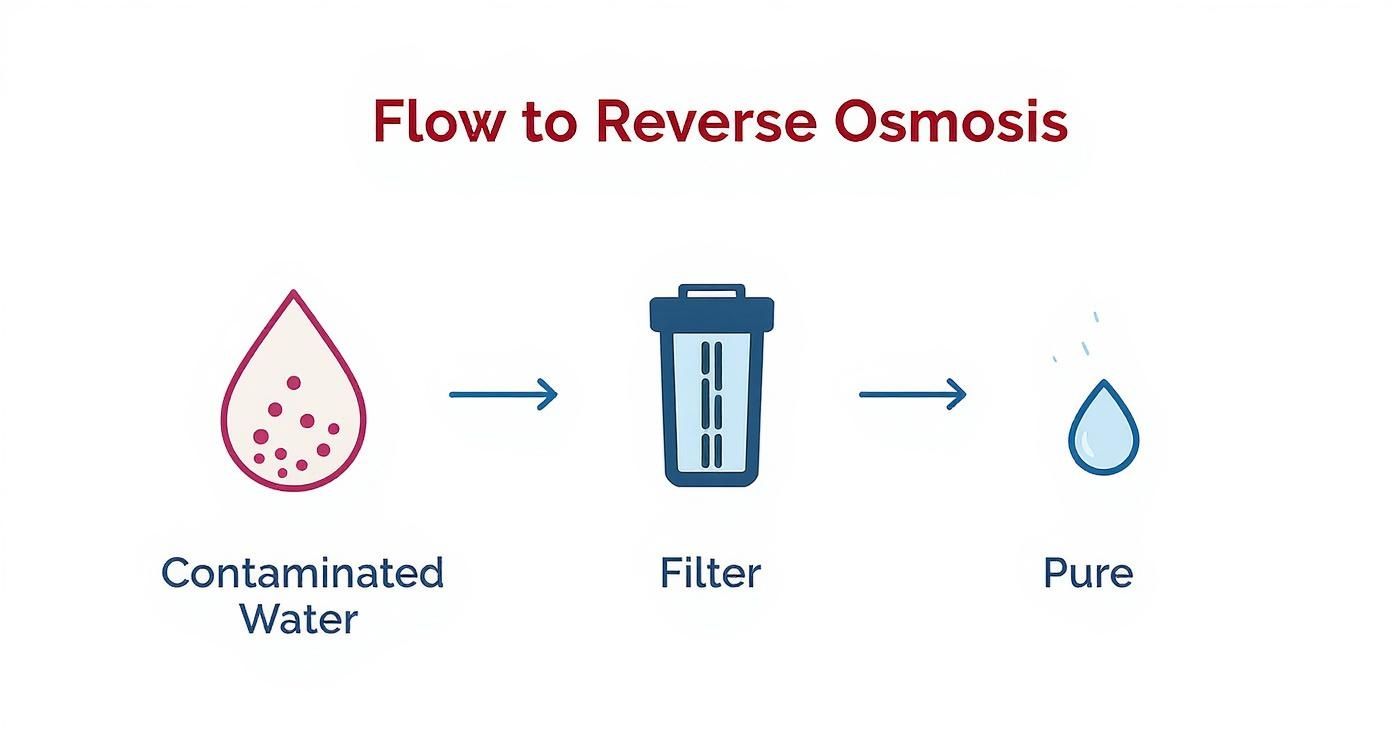
It’s a simple visual, but it captures the heart of the process: that membrane is the critical barrier between your standard tap water and truly purified water.
Stage 1: The Pre-Filters
The journey kicks off with the pre-filters, the system's essential opening act. This stage usually involves at least two separate filters: a sediment filter and a carbon block filter. Each one preps the water for the main event.
First up, the water hits a sediment pre-filter. This filter’s job is to catch the big stuff—things like dirt, rust, sand, and silt. Removing this physical debris is crucial because it protects the more delicate and expensive parts of the system further down the line from getting clogged or damaged.
Next, the water flows through a carbon pre-filter. This filter uses activated carbon to grab onto chemicals like chlorine and chloramines, which are what your local council uses to disinfect the water supply. Not only does this get rid of that swimming pool taste and smell, but it also protects the delicate reverse osmosis membrane from being eaten away by harsh chlorine.
Stage 2: The Reverse Osmosis Membrane
With the larger gunk and harsh chemicals out of the way, the water is finally ready for the heart of the system: the reverse osmosis (RO) membrane. This is where the real magic happens. As we've touched on, this semipermeable membrane is covered in microscopic pores, measuring around an incredible 0.0001 microns in size.
Using the natural pressure from your home’s plumbing, water molecules are squeezed through these tiny pores. It’s an incredibly effective barrier that stops a huge list of contaminants in their tracks, including:
- Dissolved Solids: Things like salts, nitrates, and sulphates.
- Heavy Metals: Nasty stuff like lead, arsenic, copper, and chromium.
- Fluoride: A common additive in municipal water across Australia.
- Microorganisms: While not its primary job, it’s also great at blocking bacteria and viruses.
The RO membrane is the core of any osmosis water filter system. It’s responsible for removing up to 99% of all total dissolved solids (TDS), giving you water of exceptional purity.
Stage 3: The Post-Filter and Storage
After making its way through the RO membrane, the purified water is almost ready. It’s usually stored in a small, pressurised tank, ready for you whenever you need it. When you turn on your dedicated filtered water tap, the water makes one final trip.
It flows through a post-filter, which is often another carbon filter. This final stage is really a polishing step, designed to remove any lingering tastes or odours the water might have picked up while sitting in the storage tank. This ensures that every glass of water you pour is crisp, refreshing, and delicious.
Some advanced systems, like those from Awesome Water®, might even include additional stages for things like remineralisation. You can learn more about how a more detailed process works by reading our guide on the 8 stages of an Awesome Water® filter.
What An Osmosis Filter System Actually Removes
When people talk about an osmosis water filter system, they're really talking about the gold standard in home water purification. Think of it as a microscopic gatekeeper that stands guard, separating pure, clean water from an incredibly long list of unwanted guests. This isn't just about making your water taste better; it's about fundamentally transforming your tap water by physically removing the things you'd rather not drink.
The real power of this technology is its all-in-one approach. While simpler filters might only grab chlorine or bits of sediment, a reverse osmosis system casts a much wider net. It gets right down to the molecular level, resulting in water that isn't just cleaner, but genuinely purer.
Tackling The Heavy Hitters
One of the biggest reasons Australians make the switch to reverse osmosis is its proven muscle against heavy metals. These nasties can sneak into our water supply from old plumbing or industrial runoff, and they can pose serious health risks even in tiny amounts.
An osmosis water filter system is exceptionally good at kicking these dangerous elements to the curb. The pores in its semipermeable membrane are so incredibly fine that heavy metal ions are simply too big to squeeze through. They get stopped at the gate and flushed away, far from your drinking glass.
Key heavy metals removed include:
- Lead: A potent neurotoxin that is especially harmful to children.
- Arsenic: A naturally occurring element that has been linked to various long-term health issues.
- Copper: We need a little bit, but high levels from pipe corrosion can be toxic.
- Chromium: Including the more dangerous form, hexavalent chromium.
By zeroing in on these metals, an RO system adds a vital layer of protection for you and your family. It's peace of mind in every glass.
Filtering Out Chemicals And Dissolved Solids
Beyond metals, our tap water often carries a whole cocktail of treatment chemicals and dissolved solids. While many are harmless, they can definitely affect the taste, smell, and overall quality of your water. This is another area where reverse osmosis truly shines, tackling what's known in the industry as Total Dissolved Solids (TDS).
This broad category covers all sorts of impurities that basic filters often leave behind:
- Chlorine and Chloramines: Essential for disinfecting the water supply, but they're the culprits behind that "pool" smell and taste.
- Nitrates and Sulphates: These often come from agricultural runoff and can cause problems in high concentrations.
- Fluoride: A common additive in municipal water supplies right across Australia.
Many people are especially curious whether reverse osmosis effectively removes fluoride, and the answer is a resounding yes. RO systems are incredibly effective, removing between 90-99% of fluoride. For anyone wanting to minimise their fluoride intake, our team at Awesome Water® has also created a full guide on how to remove fluoride from water using a few different methods.
An RO system’s ability to slash the TDS count is what gives the water its signature pure, crisp taste. By removing up to 99% of all dissolved solids, it leaves behind nothing but clean, refreshing H₂O.
A Barrier Against Microscopic Threats
While Australian tap water is generally safe from bugs and bacteria, you can never be too careful. An osmosis water filter system provides an incredibly strong physical barrier against these microscopic invaders.
The pores in an RO membrane are far, far smaller than bacteria and viruses, meaning they simply cannot get through. This makes reverse osmosis one of the most reliable methods for ensuring your water is microbiologically safe, effectively stopping threats like E. coli and Giardia in their tracks if they were ever present.
How RO Compares To Other Filters
To really get a feel for the power of reverse osmosis, it helps to see how it stacks up against other common filtration methods you might find. Every technology has its place, but RO offers the most complete, all-around solution.
Filtration Method Contaminant Removal Comparison
Here’s a quick look at how different filter types handle common water contaminants. You'll quickly see why RO is in a league of its own.
| Contaminant Type | Standard Carbon Filter | UV Purifier | Reverse Osmosis (RO) System |
|---|---|---|---|
| Sediment (Dirt, Rust) | Good | None | Excellent |
| Chlorine (Taste/Odour) | Excellent | None | Excellent |
| Heavy Metals (Lead, Arsenic) | Limited/None | None | Excellent |
| Dissolved Solids (TDS) | Limited/None | None | Excellent |
| Bacteria & Viruses | None | Excellent | Excellent |
| Fluoride | None | None | Excellent |
As the table makes clear, other filters are great at specific jobs—carbon is a champion against chlorine, and UV is fantastic for zapping bacteria. But only an osmosis water filter system provides excellent, broad-spectrum removal across nearly every category of contaminant you'll find in Australian water. It truly is the complete package.
Choosing the Right System for Your Home
Picking the right osmosis water filter system can feel like a big decision, but it's much simpler when you break it down. The main goal is to find a system that matches your family’s daily water habits, fits into your space, and works with your budget. Whether it’s a countertop model for a rental or a discreet under-sink unit for a homeowner, the perfect solution is all about balancing performance with practicality.
The good news is, by investing in this technology, you’re joining a growing number of Aussies who are serious about their water quality. Reverse osmosis (RO) systems are the leading technology in Australia's water purification market, and for good reason—they’re proven to remove an enormous range of contaminants. In fact, market analysis shows RO purifiers held the biggest market share in 2023 and are set to keep that top spot, with the whole Aussie water purifier market expected to hit USD 1,435.71 million by 2031.
Under-Sink vs Countertop Systems
Your first big choice is figuring out where the system will go. For most homes, it comes down to two popular options: under-sink or countertop units. Each has its own perks.
- Under-Sink Systems: These are the go-to for most homeowners. Tucked away neatly in a kitchen cabinet, they’re completely out of sight and plumbed directly into your water line. Purified water comes out of a dedicated, stylish tap installed right on your sink or benchtop, leaving your main tap free for things like washing up. It’s a clean, seamless look for anyone wanting a permanent, high-performance solution.
- Countertop Systems: A brilliant choice for renters, small apartments, or anyone who’d rather skip a permanent installation. Countertop units sit on your bench and usually connect straight to your existing kitchen tap. They pack the same powerful filtration punch as under-sink models but without needing a professional to install them. It’s a fantastic plug-and-play option for getting pure water right away.
Assessing Your Water Usage and Capacity Needs
Next up, have a think about how much purified water your household gets through each day. An osmosis water filter system’s performance is rated by its daily production capacity, measured in litres per day (LPD). This number tells you exactly how much pure water the system can create over a 24-hour period.
A small family might find a system rated around 190 LPD is more than enough for their daily drinking and cooking. But if you have a larger family or use purified water for lots of different things, you might feel more comfortable with a higher-capacity system.
When you're choosing, it’s always a smart move to pick a capacity that’s comfortably above what you think you’ll use on an average day. This way, you’ll never be caught short, even on those days when everyone seems extra thirsty.
Understanding Efficiency and Wastewater
One of the key things to look at in any osmosis water filter system is its efficiency. This is often shown as a ratio of pure water produced to wastewater (sometimes called brine) that goes down the drain. To keep the filter membrane clean, the system uses a stream of water to constantly wash away the trapped contaminants.
Older systems had a reputation for being a bit wasteful, sometimes sending several litres of water down the drain for every single litre of pure water they made. Thankfully, technology has come a long way. Modern systems from trusted brands like Awesome Water® are engineered to be far more efficient. Many now run on a close to 1-to-1 ratio, meaning for every litre of pure water you get, only about one litre is used for cleaning. This is a massive improvement that minimises water waste, making today’s systems a much more sustainable choice.
While this guide focuses on home use, the need for pure water is just as critical in other places. If you're curious about how these systems are chosen for commercial kitchens, you might find this Ultimate Guide to Water Filtration Systems for Restaurants interesting.
By carefully thinking about the type of system, your daily needs, and the unit’s efficiency, you’ll be able to confidently pick the perfect solution. You can browse a wide range of high-performance reverse osmosis systems perfect for Australian homes to find one that fits your family's lifestyle perfectly.
A Practical Guide to Installation and Maintenance
Investing in an osmosis water filter system is a brilliant move for your home's water quality, but the thought of installing one can feel a bit intimidating. The reality? It's much simpler than you think, especially when a professional handles it. And once it's up and running, keeping it in perfect shape just comes down to some simple, routine maintenance anyone can do.
While a plumber can make quick work of hooking up an under-sink system, the real key to getting years of incredible performance is what happens next. Consistent filter changes are absolutely non-negotiable. They're the single most important thing you can do to guarantee your system keeps delivering pure, safe, and fantastic-tasting water.
Your System's Maintenance Timetable
Think of your filter system like your car—it needs a regular tune-up to stay in top condition. Every filter has a specific job and a limited lifespan. Sticking to a replacement schedule is crucial for preventing clogs, protecting the delicate RO membrane, and ensuring you’re always drinking the highest quality water possible.
Here’s what a typical replacement schedule looks like:
- Sediment and Carbon Pre-Filters: These are your system's frontline defenders, catching all the initial grit, sediment, and chlorine. They work hard, so they generally need replacing every 6 to 12 months.
- Reverse Osmosis (RO) Membrane: This is the heart of the whole operation. It’s much more durable because the pre-filters protect it. An RO membrane typically lasts 2 to 3 years, though this can vary with your water quality and how much you use it.
- Carbon Post-Filter: This is the final polishing stage that makes your water taste so crisp and fresh. It should be changed out every 12 months.
Forgetting to change your filters is like trying to run a marathon in worn-out shoes—you just won't get the performance you paid for. Timely replacements are essential for protecting your investment and your family’s water quality.
Why Timely Filter Changes Are So Important
Putting off a filter change might seem harmless, but it can have a real, negative impact on your system. When pre-filters get clogged, they can no longer shield the RO membrane from harsh chemicals like chlorine, which can literally eat away at the membrane and drastically shorten its life.
Even worse, an overworked filter simply stops doing its job effectively. Contaminants that should be removed start slipping through, and your water quality drops, defeating the whole purpose of having an osmosis water filter system in the first place. For more details, check out our complete guide to water filter replacement schedules to make sure you get it right every time.
Making Maintenance Effortless
At Awesome Water®, we believe maintaining your system should be completely stress-free. That’s why we offer convenient service plans and friendly reminders to take all the guesswork out of it for you. We’ll let you know exactly when a filter change is due and can even send a technician over to handle everything.
This commitment to ongoing support ensures your system works at peak efficiency, year after year. With a simple maintenance plan in place, you can just relax and enjoy the endless benefits of pure, delicious water without ever having to mark a calendar.
So, Why Choose an Awesome Water® Filtration System?
Understanding how a reverse osmosis system works is one thing; picking the right partner to bring that technology into your home is another. At Awesome Water®, we don't just sell filters—we pair world-class purification with a genuine commitment to Australian families and businesses. It’s about giving you total peace of mind in every glass.
Our systems are built tough, using top-shelf components designed for reliability and peak performance. This means you get all the incredible benefits of reverse osmosis—unmatched purity, amazing taste, and better health—all backed by a solid three-year warranty. We reckon pure, delicious water should be a simple, dependable part of your day-to-day life.
More Than Just a Box on the Wall
What really sets Awesome Water® apart is our local, end-to-end support. We know that the service you get after installation is just as important as the system itself.
- Professional Installation: Our expert technicians make sure your system is set up perfectly from day one for flawless performance. No guesswork involved.
- Local Customer Support: Got a question? Our Australian-based team is on deck 24/7 to provide real help from people who know what they’re talking about.
- Effortless Maintenance: We take the headache out of filter changes. Our service plans and friendly reminders mean you’ll never have to worry about it.
It's clear that Aussies are demanding better water. The Australian water purifier market hit USD 1,196.00 million in 2024 and is expected to more than double by 2033. It’s no surprise that RO systems are leading the charge, thanks to their incredible power to remove contaminants. You can dive deeper into these market trends and insights on MarketResearch.com.
Choosing Awesome Water® is about investing in a promise—a promise of pure, safe, and fantastic-tasting water, delivered with the friendly, reliable service you can only get from a dedicated local expert.
Ready to taste the difference? Check out our range or give our team a buzz for a personalised recommendation today.
Common Questions About Osmosis Water Filters
As you look into the world of reverse osmosis, you're bound to have a few questions. That's completely normal. Getting clear, straightforward answers is key to feeling confident about choosing an osmosis water filter system for your home or workplace.
Let's tackle some of the most common queries we hear from our customers right across Australia.
Do RO Systems Remove Healthy Minerals?
This is probably the number one question we get, and it’s a great one. The short answer is yes—the reverse osmosis process is so incredibly fine that it removes almost everything, including beneficial minerals like calcium and magnesium, along with all the nasty stuff.
But it's important to put that in perspective. We get the vast majority of our essential minerals from the food we eat, not from the water we drink. A balanced diet is always your primary source for these nutrients.
For anyone who still prefers their water with minerals, there's an easy fix. Many modern systems, including options from Awesome Water®, can be fitted with a special remineralisation filter. This clever addition puts healthy minerals back into the water after it has been purified, giving you the absolute best of both worlds.
How Much Wastewater Is Produced?
An osmosis water filter system works by using a stream of water to constantly wash the surface of the membrane. This process flushes away all the rejected contaminants, keeping the filter from getting clogged up and ensuring it works effectively. This flush water, often called brine or wastewater, simply goes down the drain.
Now, older RO systems did have a reputation for being a bit wasteful, sometimes using several litres of water for every one litre of pure water they produced.
Thankfully, technology has come a long way. Today's high-quality systems have made huge strides in efficiency. Many now operate on a much-improved ratio, often close to 1:1. That means you're only producing about one litre of wastewater for every litre of pure, clean drinking water.
It's also worth remembering that this wastewater isn't toxic. It's just a slightly more concentrated version of your regular tap water, containing the same salts and minerals. Lots of people get creative and repurpose it for things like watering the garden or giving the floors an initial rinse, which cuts down on waste even further.
How Often Should I Change The Filters?
This is critical. Sticking to a regular filter replacement schedule is the single most important thing you can do to keep your system running at peak performance and guarantee your water quality stays top-notch.
Each filter in the system has a different job to do, which means they all have different lifespans. It's vital to follow the recommended schedule.
Here’s a general guide to keep in mind:
- Pre-Filters (Sediment and Carbon): These are the workhorses protecting the main membrane. Plan on replacing them every 6 to 12 months.
- RO Membrane: The heart of the system is much more durable. It will typically last 2 to 3 years, though this can vary depending on your local water quality and how much you use it.
- Post-Filter (Polishing Carbon): This is the final touch-up, ensuring your water tastes crisp and fresh. It should be changed once a year, or every 12 months.
Always check the manufacturer's guidelines, like those we provide at Awesome Water®, to make sure your osmosis water filter system keeps delivering the pure, delicious water your family deserves.
Ready to experience the purest water possible? Explore the full range of high-performance filtration solutions from Awesome Water® and find the perfect fit for your home or office. Visit us at https://www.awesomewater.com to learn more.