

Investing in a commercial water filtration system isn't just another operational expense—it's a strategic move. It's about safeguarding your assets, elevating your product quality, and ultimately, building a stronger brand reputation. For any business, clean water is not just a utility but a critical ingredient for success, touching everything from your equipment's lifespan to your customers' satisfaction.
Why Smart Businesses Invest in Water Filtration
Water is fundamental to nearly every modern business. The problem is, the unfiltered water flowing from municipal sources often carries a hidden payload of minerals, chemicals, and sediment that can silently wreak havoc on your operations. This is why incorporating a commercial water filtration system is a key part of any business's robust risk management framework—it’s about protecting both your operations and your people. It’s a proactive strategy, not just a reactive cost.
Think of this investment as an insurance policy for your most valuable equipment. Everything from industrial boilers and commercial dishwashers to your café’s espresso machine and the restaurant's ice makers is vulnerable. They're all at risk from the damaging effects of scale buildup and corrosion caused by hard water.
Think of scale buildup like cholesterol in an artery. It slowly restricts flow and forces the equipment to work harder and harder, leading to inefficiency, premature breakdowns, and eye-watering repair bills. A good filtration system removes these minerals before they ever get a chance to cause harm.
Protecting Equipment and Enhancing Product Quality
Consistent water quality is the unsung hero behind countless successful products and services. If you’re in the food and beverage industry, you know the taste of your water directly shapes the final flavour of your coffee, soda, baked goods, and even the ice in your drinks. Unwanted notes from chlorine or other contaminants can completely ruin product consistency and tarnish a brand’s reputation, one sale at a time.
And for sectors like hospitality, clean, clear, and odour-free water is a non-negotiable part of the customer experience. By installing a reliable filtration system, businesses can lock in several key benefits:
- Extended Equipment Lifespan: Preventing scale and corrosion means fewer maintenance calls and lower replacement costs for your expensive machinery.
- Superior Product Consistency: It guarantees that every coffee, cocktail, or meal you serve meets the same high standard of quality, no matter how the municipal water supply fluctuates.
- Enhanced Customer Satisfaction: It delivers better-tasting beverages and clearer, harder ice cubes, subtly improving the overall guest experience and their perception of your quality.
When you start viewing water filtration as an investment, the perspective shifts. It’s no longer a mandatory expense, but a powerful tool for achieving operational excellence. It drives efficiency, protects your assets, and reinforces a commitment to quality that your customers can literally taste and feel. The financial perks go beyond just saving on repairs; they also include major savings from eliminating the need for bottled water. To dive deeper into these benefits, you can learn how switching to filtered water saves money and the planet in our detailed guide.
Getting to Grips With Commercial Water Filtration Technologies
Choosing the right filtration system for your business is a bit like picking the right tool for a specialised job. You wouldn't use a hammer to turn a screw, and the same logic applies here. To make the right call, you first need to understand the engine under the hood—the technology that does the heavy lifting.
Each method is engineered to target specific impurities. Some act like a physical screen, catching unwanted bits and pieces, while others use clever chemical reactions or even light to purify your water. Getting your head around these differences is the key to matching a system to your business needs and quality standards.
This is more important than ever, as the demand for high-quality water filtration in Australia is booming. The Australian water purifier market was valued at around USD 245.34 million in 2024 and is on track to hit USD 338.75 million by 2030. This surge is all thanks to a growing awareness of water quality issues, especially in our cities. You can discover more about this market growth on TechSci Research.
Reverse Osmosis (RO): The Microscopic Gatekeeper
Reverse Osmosis, or RO, is the gold standard when it comes to water purity. Think of it as a security checkpoint so strict that only pure water molecules get the all-access pass. An RO system uses high pressure to force water through a semi-permeable membrane—a filter with pores so tiny they’re almost impossible to imagine.
This process is incredibly thorough, stripping out a huge range of contaminants.
- Dissolved Solids: Minerals like salt, calcium, and magnesium are left behind.
- Heavy Metals: Nasty stuff like lead, mercury, and arsenic are effectively removed.
- Microorganisms: Even the smallest bacteria and viruses can't make it through the RO membrane.
Because it delivers exceptionally pure water, RO is a non-negotiable for businesses where quality is everything. Cafes rely on it for the perfect coffee extraction, labs need it for sterile work, and food producers use it to guarantee product purity and taste.
Activated Carbon: The Contaminant Sponge
If RO is the gatekeeper, then an activated carbon filter is like a super-absorbent sponge. The carbon is "activated" by treating it with oxygen, which creates millions of tiny pores across its surface. This process massively increases its ability to adsorb—or trap—certain chemicals and impurities as water flows past.
It’s a chemical attraction, not a physical barrier like a sediment filter.
Activated carbon is absolutely brilliant at improving the taste and smell of water. It’s a master at removing chlorine, which is the main culprit behind that classic "tap water" flavour that can ruin a good coffee or a signature dish.
It mainly targets organic compounds and chemical disinfectants. To dive deeper, check out our guide on how a carbon water filter works and its benefits.
Ultraviolet (UV) Sterilisation: The Chemical-Free Guardian
Ultraviolet sterilisation takes a completely different path. It doesn’t physically remove anything from the water at all. Instead, it acts as a powerful, chemical-free disinfectant that zaps harmful microorganisms on the spot.
Picture a UV system as a high-tech scanner. As water flows through a chamber, it’s blasted with intense UV light that scrambles the DNA of bacteria, viruses, and other pathogens. This stops them from reproducing and renders them completely harmless.
Ideal Applications for UV Sterilisation:
- Healthcare Facilities: Essential for ensuring water used for sanitation is microbiologically safe.
- Food and Beverage: Acts as a final safety barrier to prevent contamination from waterborne bugs.
- Rainwater Harvesting Systems: A critical step for making collected rainwater safe to use.
UV is the perfect solution for any business that needs to guarantee microbiological safety without adding a single chemical to their water supply.
To help you connect the dots, we've put together a table comparing these core technologies. It breaks down what each one removes, where it shines, and what you need to keep in mind.
Comparison of Commercial Filtration Technologies
| Technology Type | Primary Contaminant Removal | Ideal Business Application | Key Consideration |
|---|---|---|---|
| Reverse Osmosis (RO) | Dissolved solids, heavy metals, viruses, bacteria, minerals | Cafes, laboratories, food manufacturing, pharmaceuticals | Produces some wastewater (brine); may require pre-treatment |
| Activated Carbon | Chlorine, pesticides, herbicides, volatile organic compounds (VOCs) | Restaurants, offices, hospitality (improves taste & odour) | Doesn't remove minerals, salts, or dissolved solids; filter needs regular replacement |
| UV Sterilisation | Bacteria, viruses, protozoa, and other microorganisms | Healthcare, food service, rainwater systems, well water | Doesn't remove sediment or chemicals; requires clear water to be effective |
| Sediment Filtration | Dirt, sand, rust, silt, and other suspended particles | All applications (as a pre-filter), agriculture, manufacturing | A foundational first step; doesn't remove chemical or biological contaminants |
This comparison should give you a clearer picture of which tool is right for your specific job. Each has its strengths, and often, the best systems combine two or more of these technologies for comprehensive protection.
The infographic below really drives home how these technologies can boost everything from equipment longevity to your bottom line.
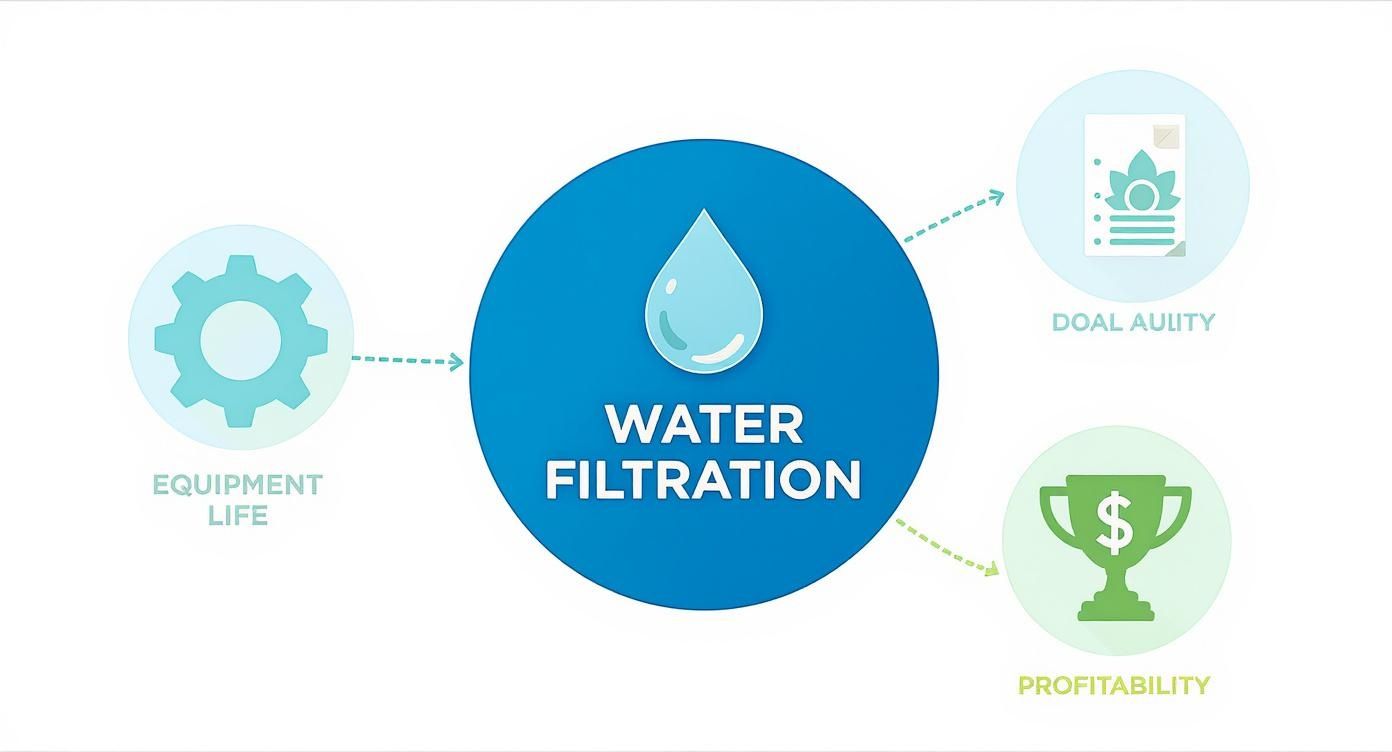
As you can see, investing in the right water filtration is a direct investment in your business's profitability and reputation.
Sediment Filtration: The First Line of Defence
Last but not least, we have sediment filtration. It’s the simplest but arguably one of the most important parts of any commercial system. Think of it as the bouncer at the front door, stopping the big troublemakers from getting inside.
This filter works like a basic screen, physically blocking visible particles like:
- Dirt
- Sand
- Silt
- Rust flakes from old pipes
By catching all this larger debris at the very start, sediment filters act as bodyguards for the more sensitive and expensive stages downstream. They prevent things like RO membranes and carbon filters from clogging up, which means they last longer and perform better. Simple, but essential.
Matching a Filtration System to Your Industry Needs
Getting your head around the different filtration technologies is the first step. But the real trick is figuring out which one actually fits your business. Not all commercial water filtration systems are built the same, because no two businesses have the same needs. A system that’s perfect for a big office block could be a total disaster for a busy café or a sterile medical clinic.
Let's move from the technical jargon to what it means on the ground. Think of it like buying a vehicle for your business. A courier needs a zippy, fuel-efficient van. A construction crew needs a tough, reliable ute. A limo service needs a sleek, comfortable sedan. They all get you from A to B, but they’re designed for completely different jobs. Water filtration is no different.
Hospitality and Food Service Success
For restaurants, pubs, and cafés, water isn’t just for cleaning up. It's a core ingredient. The quality of your water directly shapes the taste of everything you serve—from the crema on your coffee and the fizz in your soft drinks to the clarity of your ice. In this game, it’s all about taste, odour, and consistency.
Your espresso machine, for instance, is incredibly sensitive to hard water. Scale buildup from minerals can wreck expensive parts and lead to bitter, inconsistent shots. At the same time, the hint of chlorine from the tap can ruin a perfectly brewed cuppa or a craft cocktail.
- Ideal System: You'll almost always need a multi-stage approach. This usually starts with a sediment pre-filter to catch grit and protect your gear, followed by an activated carbon filter to zap chlorine and improve taste. A water softener or scale-reduction system is also crucial to prevent limescale.
- Real-World Example: Think about a microbrewery. They need absolute control over their water chemistry to brew the same great-tasting IPA every single time. They use carbon filters and reverse osmosis to create a pure, blank slate, then add back specific minerals to get the exact water profile they need.
For anyone in the foodservice industry, the right water filter is non-negotiable. You can explore some of the best water filters for restaurants and commercial kitchens to see just how specific these solutions can get.
Healthcare and High-Purity Applications
Switch gears to a medical or dental clinic, and the priorities flip entirely. Taste barely matters, but sterility and purity are everything. The water used to sterilise instruments in an autoclave or run through a dental chair’s lines must be completely free of microorganisms and minerals.
Here, even a trace of bacteria or minerals could put patient safety at risk or damage extremely sensitive equipment. The standards for filtration are far, far higher than in almost any other commercial setting.
For healthcare, the focus shifts from aesthetic qualities like taste to the absolute removal of microbiological and chemical contaminants. The goal is to produce water that is as close to pure H₂O as technically possible to ensure safety and compliance with health standards.
Achieving this level of purity usually means teaming up advanced technologies. Reverse osmosis is the workhorse, removing the vast bulk of contaminants. This is often followed by a UV sterilisation lamp as a final safety net to neutralise any microbes that might have slipped through.
Offices and Corporate Environments
In an office, the goal is simpler: employee wellness and convenience. You want to give your team safe, great-tasting drinking water to keep them hydrated and happy, while also cutting down on single-use plastic bottles. This is where point-of-use (POU) systems like water coolers and under-sink filters really come into their own.
Australia’s food and beverage sector, which pulled in around USD 133.6 billion in 2021, runs on high-quality water, and that same expectation is now the norm in corporate spaces. It’s no surprise that POU systems are so popular, making up about 84.36% of the market revenue share for the wider water treatment industry in 2024.
These systems are simple, cost-effective, and provide an instant upgrade to the taste and smell of water, right where people need it. For a deeper dive, check out our guide on choosing the right water filtration system for your home or business for some extra tips.
How to Size and Plan Your System Installation
Choosing the right filtration technology is a huge step, but it’s only half the battle. A perfectly matched system can still fail miserably if it isn't sized and installed correctly. Think of proper planning as the critical bridge between selecting your equipment and actually enjoying its benefits.
It’s a bit like choosing an engine for a vehicle. An undersized engine will strain and choke when you need power, while an oversized one is just a waste of fuel and money. Your commercial water filter works the same way; it must be perfectly scaled to your business’s unique demands to perform efficiently.
An undersized system will struggle to keep up during peak periods, leading to frustrating drops in water pressure and quality. On the other hand, a system that’s far too large for your needs means you’ve overspent on the initial purchase and will keep overspending on maintenance and filter replacements.
Calculating Your Business Water Needs
Before you can even think about which model to buy, you need a crystal-clear picture of your water consumption. This isn't just about your total monthly usage from a bill. It's about getting granular and understanding the daily peaks and troughs of your operation.
Start by gathering data on these key metrics:
- Daily Water Consumption: How many litres does your business use on an average day? Check your water bills, but don't forget to factor in the specific demands of your high-use equipment.
- Peak Flow Rate: This is the absolute maximum amount of water you might need at any single moment. Imagine a busy restaurant kitchen during the dinner rush—dishwashers, ice machines, and taps all running at once. This figure is usually measured in litres per minute (LPM).
- Existing Water Pressure: Your building’s water pressure (measured in psi or kPa) directly impacts how well a filtration system can operate. Some systems, like reverse osmosis, need a certain minimum pressure just to function.
Once you have these numbers, you can work with a professional to choose a system that can handle your peak demand without breaking a sweat.
Your Essential Pre-Installation Checklist
A smooth installation process begins long before the technicians show up with their tools. Doing your homework minimises surprises, prevents costly delays, and ensures your system is set up for success from day one. Skipping these steps can lead to nasty compatibility issues or unexpected plumbing work.
Planning your installation is about more than just finding a spot for the unit. It’s a strategic process that involves assessing your water, understanding your plumbing, and verifying the physical requirements to ensure a seamless integration into your workspace.
Use this checklist to cover all your bases:
- Get a Professional Water Test: Don’t guess what’s in your water. A comprehensive lab test will identify the specific contaminants you need to target, confirming you've chosen the right filtration technology.
- Assess Your Plumbing: Get familiar with your current plumbing setup. Will you need new pipes, bypass valves, or dedicated lines for the filtered water? A qualified plumber can help you map this out.
- Confirm Space and Utilities: Does the system need electricity? Is there a nearby drain for wastewater (this is essential for RO systems)? Get out the measuring tape and ensure the unit and any tanks will fit comfortably.
- Plan for Downtime: A new installation will likely require shutting off the water supply for a period. Schedule the work during off-peak hours or a planned closure to minimise disruption to your business.
Thoroughly preparing for a water filter installation in Sydney or any other major Australian city involves careful planning and professional guidance. Taking these steps ensures your project runs smoothly and your investment pays off.
Maintaining Your System for Longevity and Performance
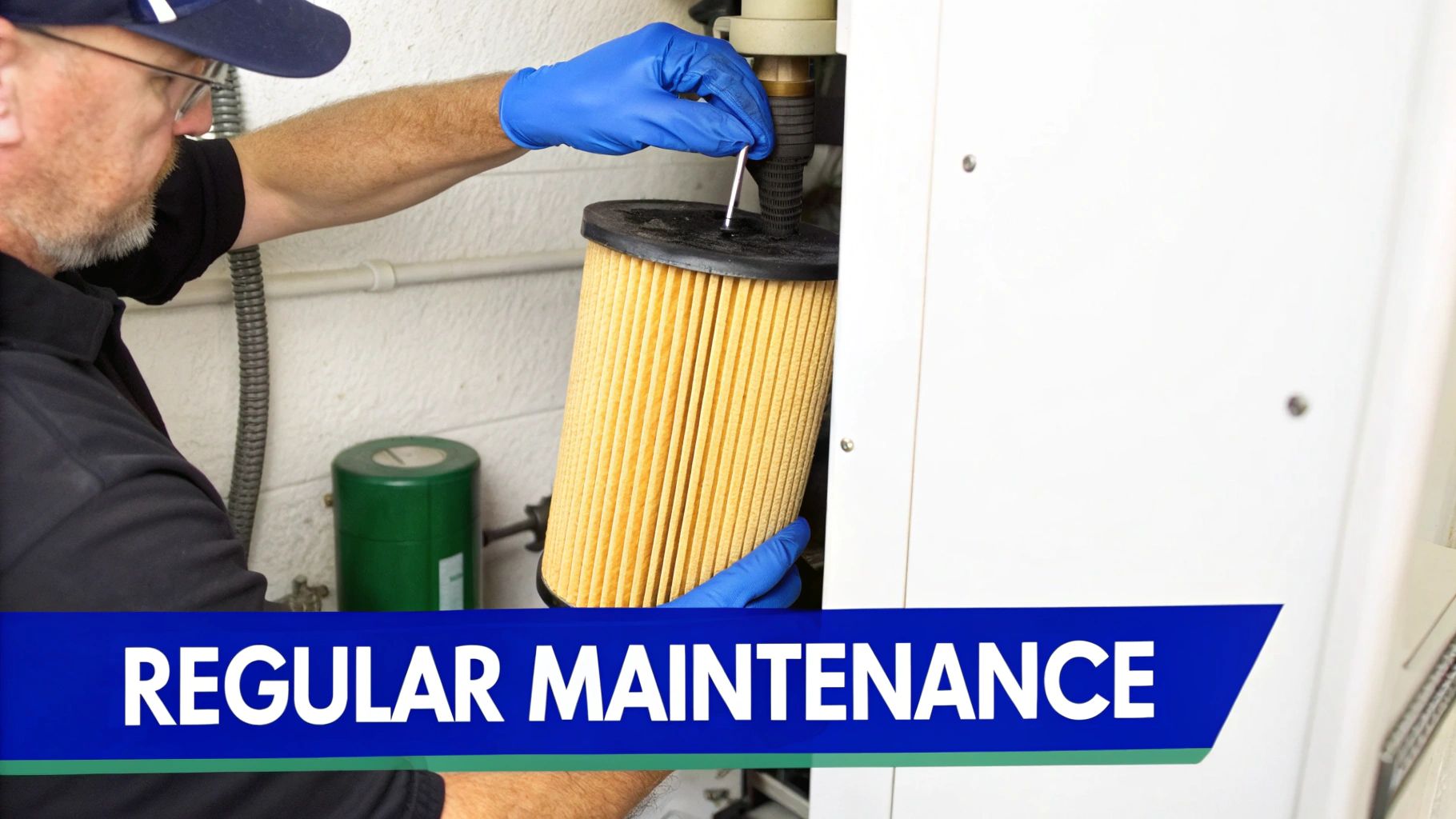
Think of your commercial water filtration system like a high-performance engine. When you give it regular attention, it runs smoothly, reduces unexpected downtime, and guarantees consistent water quality for your business.
Adopting a proactive maintenance mindset is key. Just as regular oil changes keep a car’s engine humming, timely filter changes keep your water flowing clear and safe. It's about preventing problems before they start.
- Regular Filter Replacement ensures contaminants don't build up and degrade performance.
- Scheduled System Checks help you catch small leaks or signs of wear before they become expensive emergency repairs.
- Detailed Record Keeping gives you a clear picture of how long parts are lasting, helping you plan your budget with confidence.
Maintenance Schedules That Work
Not all filters are created equal, and their lifespans vary depending on the type and how heavily you use them. As a general guide, sediment filters might need replacing every 3 to 6 months, while carbon filters often last between 6 to 12 months. High-performance reverse osmosis membranes can keep going for up to 2 years before you’ll see a significant drop in performance.
A well-planned service calendar is like following a vehicle’s maintenance log; it prevents costly surprises and keeps your team confident.
Sticking to a schedule means you can avoid common headaches like pressure drops, off-tastes in your water, or microbial growth in your downstream equipment. Your maintenance intervals should always factor in your facility’s daily water volume, peak demand, and the quality of your incoming water supply.
- In-house Maintenance Pros can offer speed and control, but you'll need properly trained staff and dedicated time for it.
- Professional Service Contracts bring in expert technicians with preventative care plans and guaranteed response times, offering total peace of mind.
To get the most out of your system, check out our guide on effective filter care: How to Maintain a Water Filter to Prolong Its Life.
Balancing DIY and Professional Care
Deciding between in-house and outsourced maintenance really comes down to balancing cost and reliability. An in-house team is great for spotting emerging issues on a daily basis but might not have the specialised knowledge for more complex problems. On the other hand, service contracts often bundle parts, labour, and priority scheduling—but come with a fixed cost.
| Maintenance Model | Pros | Cons |
|---|---|---|
| In-house | Lower labour cost, full control over scheduling | Training required, potential for oversight |
| Professional Contract | Expertise, fast response, routine inspections included | Fixed fees, less immediate control |
Integrating sustainability into your maintenance is also becoming crucial. The Australian filtration market is set to grow at a 5.7% CAGR through 2025–2033, largely driven by demand for eco-friendly systems that use less energy and create less waste.
Let’s look at a quick real-world example. A mid-sized café in Melbourne started logging all their maintenance dates and filter changes. This simple habit led to a 15% reduction in unexpected downtime and saved them over $4,800 in emergency repair bills in just one year.
Here’s how they did it:
- Set automated calendar reminders four to six weeks before each filter's expected end-of-life.
- Train staff to take weekly readings of water pressure and flow rates.
- Review the maintenance logs every quarter to spot any unusual trends or spikes in usage.
This kind of proactive habit is what keeps a system running reliably, day in and day out, without any nasty surprises.
The Real Cost and Your Return on Investment
Let’s be honest: putting in a commercial water filtration system is a serious investment. But looking only at the sticker price is like judging a car by its paint job—it doesn’t tell you the whole story. What you really need to get your head around is the Total Cost of Ownership (TCO).
This isn’t just about the initial outlay for the gear. The TCO gives you the complete picture, factoring in everything from the day it’s installed to the day it’s replaced. It includes the purchase price, the cost to get it professionally plumbed in, and all the predictable running costs like new filters and any extra power or water the system might use.
The Tangible Savings: Where the Magic Happens
While it's important to know the costs, the exciting part is the Return on Investment (ROI). This is where the system stops being an expense and starts becoming a money-saving asset for your business. The savings often pop up in places you might not expect.
The most obvious win is protecting your expensive equipment.
- Fewer Repair Bills: Scale buildup is a killer for coffee machines, boilers, ice makers, and dishwashers. By filtering it out, you’re preventing breakdowns and avoiding those painful emergency call-out fees.
- Lower Power Bills: A water heater or boiler caked in scale has to work much harder to do its job. Clean, filtered water means they run efficiently, and you’ll see the difference in your gas and electricity bills.
- Ditch the Bottled Water: If you’re buying bottled water for your staff or customers, you can stop. That’s a recurring expense—often thousands of dollars a year—gone for good.
Calculating ROI isn't just a simple maths problem. It’s about seeing the ripple effect. One smart investment can send waves of savings across your entire operation, making everything run smoother and protecting your gear from an early grave.
The “Hidden” Returns That Build Your Brand
Beyond the dollars and cents you can track on a spreadsheet, great water delivers some powerful, intangible benefits. These are the kinds of returns that strengthen your brand, improve your team’s morale, and quietly add to your bottom line.
Think about it. A café that becomes known for its incredibly smooth coffee, or a restaurant praised for its crystal-clear ice cubes, is building a reputation for quality. That’s the kind of thing that brings customers back time and time again.
And what about your staff? Providing clean, great-tasting water shows you actually care about their wellbeing. It’s a small perk that can make a big difference to morale and satisfaction, helping you keep good people around.
Ultimately, it all comes down to peace of mind. Knowing you’re serving safe, high-quality water protects your customers, your reputation, and your business. All these benefits together make a commercial water filtration system not just a purchase, but a powerful investment in your future.
Got Questions? We've Got Answers
When you're looking into a commercial water filtration system, a few questions always seem to pop up. Getting straight answers is the key to making a smart investment in your business's water quality, so we've put together some of the most common queries we hear from business owners just like you.
Think of this as your cheat sheet. By the end, you'll have a much clearer picture of how a great filtration system fits into your day-to-day operations and helps your bottom line.
How Often Do I Need to Replace Commercial Water Filters?
There’s no single answer here, as the lifespan of a filter really depends on what kind it is, how much water you're pushing through it, and the quality of the water coming into your building in the first place.
It helps to think of them in tiers:
- Sediment Filters: These are your first line of defence, catching all the larger gunk and grit. You'll typically want to swap these out every 3-6 months.
- Activated Carbon Filters: These workhorses tackle taste and odour. Plan on replacing them every 6-12 months.
- Reverse Osmosis (RO) Membranes: As the heart of an RO system, these are built for the long haul. They can often last 2-3 years or even longer.
Your best bet is to always follow the manufacturer's specific guidelines for your model. Sticking to a regular replacement schedule is the single best thing you can do to keep the system running perfectly and protect your equipment from damage.
Think of filter replacement like scheduled maintenance for a company vehicle. You might save a few dollars by skipping an oil change, but it always leads to poor performance and much bigger, more expensive problems later. Consistent care guarantees reliability.
Can a Filtration System Actually Lower My Utility Bills?
Yes, it absolutely can. While the main game is pure, clean water, a fantastic side effect is better energy efficiency, which you'll see reflected in your utility bills. It all comes down to stopping scale buildup before it starts.
When minerals like calcium and magnesium create that hard, crusty scale inside your boilers, coffee machines, and water heaters, the equipment has to work overtime just to heat the water. All that extra effort burns through more electricity or gas. By filtering those minerals out before they can cause trouble, a filtration or softening system lets your heating elements do their job efficiently. Over time, that efficiency adds up to real savings.
What's the Difference Between Water Filtration and Water Softening?
This is a really common point of confusion because the terms are sometimes thrown around interchangeably, but they do two completely different jobs. The easiest way to think about it is that filtration is like a microscopic net, while softening is more like a magnet.
Water filtration is all about catching and removing a wide range of contaminants to improve the purity, safety, taste, and smell of your water. It targets things like:
- Sediment, rust, and silt
- Chlorine and other chemicals
- Bacteria and viruses
- Dissolved solids
Water softening, on the other hand, has a very specific mission: it goes after the "hard" minerals, mainly calcium and magnesium, that cause scale buildup. It doesn't purify the water in the same way filtration does, but it's brilliant at protecting your plumbing and appliances from getting clogged up. For the ultimate water treatment, many businesses end up using both systems together.
Ready to give your staff and customers pure, great-tasting water? Awesome Water® has a full range of commercial water filtration systems built for Australian businesses. Explore our solutions and find the perfect fit for your workplace at awesomewater.com.