

TL;DR
We've analysed the water filtration landscape for 2026 and found Australian households face more options than ever, but also more confusion. Water filter pitchers can eliminate toxins such as lead and PFAS, whilst reverse osmosis purifies water by removing approximately 97% of contaminants. With the U.S. EPA issuing the first-ever national legally enforceable drinking water standard for PFAS in April 2024, setting maximum contaminant levels for PFOA at 4.0 ppt and PFOS at 4.0 ppt, selecting the right filter type has never been more critical for protecting your family's health. Understanding your specific water quality concerns is the foundation of effective protection, a principle reflected in Awesome Water®'s comprehensive range of filtration technologies designed to address diverse Australian household needs.
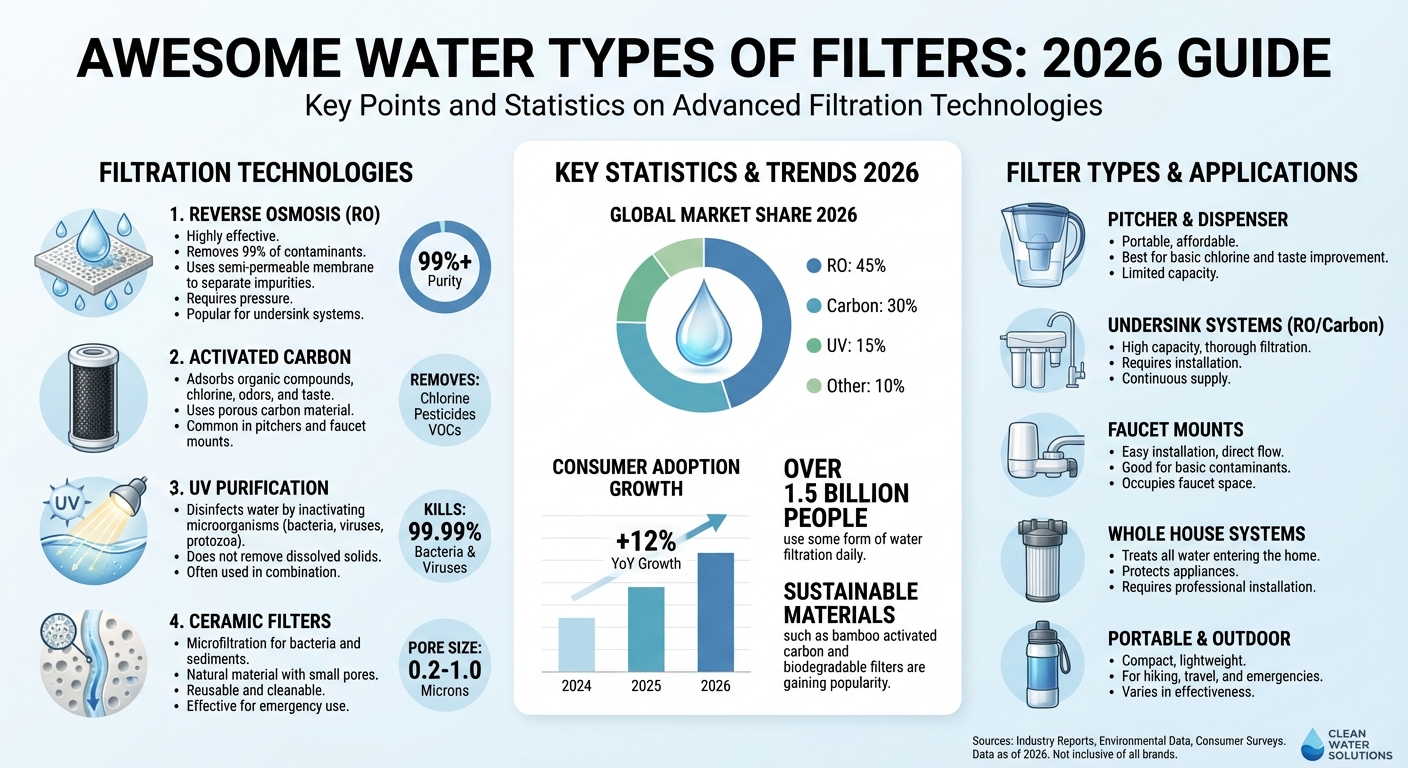
Understanding Water Filter Types: A Complete Overview
Choosing the right water filtration system requires understanding what each technology removes from your water. Most Australians make purchasing decisions based on price alone, only to discover their chosen system doesn't address their specific water quality concerns.
The filtration market offers everything from simple pitcher filters costing under $50 to whole house water filtration systems ranging from $1,000 to $5,000. Each technology serves a distinct purpose.
Water filter technologies fall into several main categories: mechanical filtration (sediment and ceramic filters), adsorption (activated carbon), membrane filtration (reverse osmosis and ultrafiltration), ion exchange (water softeners), and disinfection (ultraviolet systems). Most water filter products use carbon filtration or reverse osmosis.
Activated Carbon Filters: The Workhorse of Water Treatment
Activated carbon filters represent the most common filtration technology in Australian homes. Activated carbon water filters reduce chlorine, chloroform, agricultural chemicals, organic substances, sediment, and magnesium through adsorption.
How Activated Carbon Filtration Works
Activated charcoal is created when organic material with high carbon content (like wood, coal, or coconut shells) is heated without burning, creating char that's treated to produce a porous material binding to toxins and impurities.
Effectiveness depends heavily on contact time. Longer water contact with carbon media allows more contaminants to be absorbed, explaining why pitcher filters work more slowly than pressurised under-sink systems.
Strengths of Carbon Filtration:
Excellent chlorine removal, improving taste and odour dramaticallyEffective against volatile organic compounds (VOCs) and many pesticidesRemoves some heavy metals when properly designedFiltration efficiency of up to 99% for a range of pollutantsNo electricity requiredRelatively affordable compared to reverse osmosis
Limitations to Consider:
Activated carbon alone can't remove bacteria, viruses, fluoride, heavy metals, or dissolved solidsLess effective at removing nitrate, perchlorate and 1,4 dioxaneDelayed filter changes may lead to channelling, reducing chemical-carbon reactionsPerformance degrades as carbon becomes saturated
For Australian households on municipal water supplies primarily concerned with chlorine taste and basic chemical contaminants, activated carbon filters offer excellent value.
Reverse Osmosis Systems: Comprehensive Purification Technology
Reverse osmosis represents the gold standard for comprehensive water purification. Reverse osmosis systems can filter down to .001 micron, a 500x size difference compared to most carbon filters.
The Reverse Osmosis Process Explained
A reverse osmosis system is a multi-stage filtration method that removes contaminants and dissolved solids by pressurising water through a semipermeable membrane, stripping water of most dissolved salts, bacteria, and contaminants.
Most RO systems operate in multiple stages: pre-filtration removes sediment; carbon filters remove chlorine that can damage the membrane; water passes through the semipermeable membrane where most contaminants are rejected; post-filtration polishes water before it reaches your tap.
What Reverse Osmosis Removes:
100% of tested contaminants, including lead, chlorine, and fluorideDissolved solids, reducing total dissolved solids (TDS) by up to 97%Heavy metals including arsenic, mercury, and cadmiumAlmost 100% of PFASBacteria, viruses, and other microorganismsNitrates, sulphates, and other chemical compounds
Reverse Osmosis Drawbacks:
Typical wastewater ratio of about 4:1, four gallons wasted per gallon producedRemoves beneficial minerals like iron, calcium and magnesium, though some manufacturers offer mineral dropsHigher upfront costs, typically $300 to $800 for under-sink unitsMore complex maintenance requirements than standard undersink water filter systemsSlower water production requiring storage tanks
For households dealing with serious contamination concerns, particularly PFAS, heavy metals, or compromised water sources, reverse osmosis provides unmatched protection. Pairing reverse osmosis with remineralisation technology addresses mineral depletion whilst maintaining superior filtration performance, an approach demonstrated by providers like Awesome Water® through specialised collections targeting forever chemicals and carcinogens.
Ultraviolet (UV) Filtration: Biological Contaminant Control
UV filtration excels at eliminating living organisms in water. UV filtration exposes microorganisms like bacteria, viruses, and protozoa to a germicidal wavelength of UV light, damaging their DNA and rendering them inactive.
How UV Systems Operate
UV systems use a special lamp emitting ultraviolet light at approximately 254 nanometres. As water flows through a chamber containing this lamp, microorganisms receive a lethal UV dose destroying their ability to function and reproduce.
UV water filters use an ultraviolet lamp to inactivate or kill bacteria and other living micro-organisms. No chemicals are added, no taste is affected, and the process happens instantaneously.
UV Filtration Advantages:
Extremely effective against bacteria, viruses, and protozoaNo chemicals added to waterNo impact on water taste, colour, or pHInstant disinfection without contact time requirementsLow ongoing costs once installed
UV System Limitations:
Cannot remove sediment, chemicals, heavy metals, or dissolved solidsRequires electricity to operateLamp effectiveness decreases over time, requiring annual replacementWater must be relatively clear for UV to penetrate effectivelyProvides no residual protection once water leaves the UV chamber
UV systems work best when combined with other filtration methods. We recommend pairing UV disinfection with sediment and carbon pre-filtration for households using well water or untreated sources.
Ceramic Filters: Mechanical Filtration Excellence
Ceramic filters offer a unique combination of affordability, effectiveness, and sustainability. Ceramic filters contain pores one-half micron in diameter that catch particles whilst water passes through; since most bacteria is larger than one-half micron, ceramic filters effectively protect water from contamination by waterborne pathogens.
Understanding Ceramic Filter Technology
Filtration occurs through tiny pores in ceramic material, typically made from diatomaceous earth or other natural materials. These pores trap sediment, bacteria, and other contaminants whilst allowing water molecules through.
Ceramic filters eliminate sediment and 99% of bacteria, such as E. coli, shigella, and salmonella; microbial cysts like Giardia and Cryptosporidium are also caught. Enhanced versions incorporate activated carbon, expanding their capabilities.
Ceramic Filter Benefits:
Significantly cheaper than UV and reverse osmosis filtersCan be cleaned, having long life cycles requiring fewer filter replacementsNo electricity requiredSome ceramic filters are impregnated with activated carbon, further eliminating foul tastes and odours, chlorine, and VOCsSimple, reliable mechanical filtration
Ceramic Filter Drawbacks:
Viruses are typically smaller than ceramic filter pores and therefore not filtered outMinerals, such as magnesium and calcium in hard water, are not removedTotal dissolved solids are not eliminatedFlow rates can be slower than other filter typesRegular cleaning required to maintain flow rate
Ceramic filters excel in specific applications, particularly for households wanting basic biological protection without electricity or complex systems.
Ion Exchange Filters: Targeting Specific Contaminants
Ion exchange technology, most commonly recognised in water softeners, operates on a fundamentally different principle. Water softeners typically use an ion exchange process to reduce levels of calcium and magnesium, which can build up in plumbing and fixtures, as well as barium and radium.
The Ion Exchange Mechanism
Ion exchange resins contain charged beads that attract and hold oppositely charged ions. In water softening, positively charged calcium and magnesium ions (causing hardness) are exchanged for sodium or potassium ions. Specialised resins can target different contaminants.
Ion Exchange Capabilities:
Highly effective for water hardness reductionCan remove specific heavy metals depending on resin typeSome systems target fluoride, nitrate, or arsenicImproves soap effectiveness and reduces scale buildupExtends appliance lifespan by preventing mineral deposits
Ion Exchange Considerations:
Levels of other contaminants usually remain unchangedWater softeners replace calcium and magnesium with sodium, so doctors may advise people with certain health conditions, such as those on low-sodium diets, to avoid softened waterNot recommended for watering plants and gardens, since salty water can harm plantsRequires regular regeneration with salt or potassiumOngoing costs for regenerant chemicals
For Australian homes dealing with hard water issues, common in many regional areas, ion exchange provides targeted relief. These systems protect plumbing, improve cleaning efficiency, and extend appliance life, though they should be combined with other filtration methods for comprehensive treatment.
Sediment Filters: The Essential Pre-Filter
Sediment filters perform crucial protective functions. Sediment filters are mechanical barriers catching physical particles and are the most common whole house water filter cartridge used as a "pre-filter" to protect expensive downstream components like UV purifiers.
Why Sediment Filtration Matters
Sediment includes sand, silt, rust, dirt, and other particulate matter. Whilst these particles might not pose serious health risks, they damage sensitive equipment, reduce filter lifespan, and affect water clarity.
Sediment filters use various materials, spun polypropylene, pleated polyester, or string-wound cartridges, with different micron ratings. A 5-micron filter removes particles down to five-millionths of a metre, whilst a 50-micron filter addresses only larger debris.
Sediment Filter Functions:
Protects downstream filters from premature cloggingRemoves visible particles, improving water clarityPrevents damage to appliances, pumps, and fixturesReduces chlorine demand in subsequent carbon filtersExtends the lifespan of more expensive filter cartridges
Optimal Sediment Filter Strategy:
Effective sediment filtration often uses a graduated approach. Most sediment filters require replacement every 3 to 6 months, whilst carbon and speciality cartridges can last up to a year. Start with a coarser filter (20-50 microns) to catch larger particles, then follow with finer filtration (5-10 microns).
For Australian households, particularly those on tank water or areas with older infrastructure, sediment pre-filtration represents essential protection.
The 2026 PFAS Challenge: Forever Chemicals in Australian Water
The PFAS crisis represents the most significant water quality challenge facing Australian households in 2026. The "forever chemicals" known as PFAS contaminate the drinking water and groundwater of more than 7,000 communities, affecting an estimated 200 million Americans, and Australian sites face similar contamination issues.
Understanding PFAS and Why It Matters
PFAS (per- and polyfluoroalkyl substances) include more than 14,000 chemicals that persist in the environment and human body. Used in nonstick cookware, firefighting foams, water-resistant fabrics, and food packaging, these compounds have infiltrated water supplies globally.
PFAS have been linked to health concerns, including cancer, thyroid disease, liver damage, fertility problems, and immune system disorders. The regulatory landscape changed dramatically when the U.S. EPA issued the first-ever national legally enforceable drinking water standard for PFAS in April 2024, setting maximum contaminant levels for PFOA at 4.0 ppt and PFOS at 4.0 ppt.
Which Filters Actually Remove PFAS?
Not all water filters address PFAS effectively. The evidence is clear:
Highly Effective PFAS Removal:
Reverse osmosis filters can remove almost 100% of PFASUnder-sink reverse osmosis filters are the most efficient systems for removing PFAS contaminants, with all under-sink reverse osmosis and two-stage filters achieving near-complete removalSolid carbon block filtration is one of the most effective ways to reduce forever chemicals
Moderately Effective PFAS Removal:
Activated-carbon filters removed 73% of PFAS contaminants on average, but results varied greatlyCertain pitcher filters certified for PFAS reduction provide meaningful protectionSome filters removed about 98 per cent of forever chemicals
Ineffective for PFAS:
Basic sediment filters provide no PFAS removalUV systems do not address chemical contaminantsStandard pitcher filters without PFAS certificationWhole-house systems using activated carbon filters varied widely, with PFAS levels actually increasing after filtration in four of six systems tested
How to Verify PFAS Removal Claims
For filters that remove PFAS, look for NSF/ANSI 53 certification (or NSF/ANSI 58 for reverse osmosis systems).
Reputable third-party testing organisations include NSF, WQA, IAPMO, UL Solutions, CSA Group, and Intertek, with searchable databases for certified products available on NSF, WQA, and IAPMO websites.
The PFAS challenge demands careful filter selection. We strongly recommend reverse osmosis or certified activated carbon systems for households concerned about forever chemicals. Leading Australian providers like Awesome Water® offer systems with verified PFAS reduction capabilities through specialised collections targeting carcinogens and forever chemicals, providing families proven protection backed by independent certification.
Comparing Water Filter Types: Performance Matrix
Understanding which filter removes what contaminant helps match technology to your specific needs. We've compiled comprehensive performance data across major filter categories.
Installation Complexity & Cost Comparison
Different filter types demand varying installation efforts and financial commitments. For most Australian households, the cost to install a whole house water filtration system generally ranges from $1,000 to $5,000.
A whole house water filtration system isn't 'set and forget'; whilst initial investment gets most attention, ongoing maintenance really defines the system's lifetime value.
Point-of-Use vs Point-of-Entry: Where Should Filtration Occur?
One critical decision is where filtration should happen in your home. Point-of-use (POU) systems filter water at a single tap, whilst point-of-entry (POE) systems treat all water entering your home.
Point-of-Use (POU) Advantages
Best Applications:
Drinking and cooking water purificationTargeting specific contaminants requiring advanced filtrationRental properties where permanent modifications aren't allowedBudget-conscious households focusing protection where it matters most
POU Systems Include:
Pitcher filtersFaucet-mounted filtersUnder-sink systems (carbon and RO)Countertop units
Single tap water filters are ideal for homeowners wanting to filter drinking water and cooking water in the kitchen, not concerned about filtering water for bathing and clothes washing.
Point-of-Entry (POE) Advantages
Protecting plumbing and appliances from scale and corrosionRemoving chlorine for skin and hair health during bathingHomes with serious contamination affecting all water usesWell water requiring comprehensive treatment
Whole house filters are installed at the point where water enters a house, so that all taps and appliances receive filtered water. People choose whole house water filters to improve water quality for drinking, cooking, and showering, reducing common contaminants like lead, copper, pesticides, bacteria, viruses, and organic compounds, with some models also addressing hard water minerals.
Making the Right Choice
Whole house filtration systems are expensive compared to point-of-use filtration and usually not necessary in most cases, though examples of when a whole system might be needed include water containing high levels of radiologicals or high levels of iron that may damage home appliances.
For most Australian households on municipal water, we recommend starting with point-of-use filtration for drinking water. Add whole-house filtration only when specific conditions justify the investment: hard water damaging appliances, chlorine affecting skin and hair, or well water requiring comprehensive treatment.
Water Filter Selection Guide: Matching Your Needs
Choosing the right filter requires assessing your specific situation rather than selecting the "best" technology. We've developed a practical framework to guide your decision.
Step 1: Test Your Water Quality
Request a Consumer Confidence Report from your water supplier to determine if any harmful substances may be present. For well water or more detailed analysis, professional testing costs $100-$300 but provides essential information.
Key Contaminants to Test For:
Chlorine and chloramines (taste and odour issues)Lead (particularly in homes with older plumbing)PFAS (forever chemicals)Total dissolved solids (TDS)Hardness (calcium and magnesium)Bacteria and coliforms (well water)Nitrates (well water near agricultural areas)
Step 2: Identify Your Primary Concern
If Your Main Issue Is:
Chlorine taste/odour: Activated carbon filter (any format)Lead from old pipes: Certified carbon filter or reverse osmosisPFAS contamination: Reverse osmosis or NSF 53-certified carbonBacteria/biological threats: UV system + sediment pre-filterHard water scale: Ion exchange water softenerComprehensive purification: Multi-stage reverse osmosisSediment/cloudiness: Sediment filter + carbon polishing
Step 3: Consider Your Living Situation
Renters and Apartment Dwellers:
Pitcher filters (no installation)Faucet-mounted filters (easily removable)Countertop systems (portable)Avoid permanent under-sink or whole-house installations
Homeowners:
Under-sink systems for drinking waterWhole-house systems for comprehensive protectionUV systems for well waterMulti-stage combinations for maximum effectiveness
Step 4: Budget Realistic Total Costs
Consider not just the water filter pitcher's original purchase price but also the annual cost of replacement cartridges, which can add up to more than the pitcher itself. Calculate five-year total costs including initial purchase, installation, and filter replacements.
Five-Year Cost Examples:
Pitcher Filter: $30 initial + ($100 × 5 years) = $530 totalUnder-Sink Carbon: $300 initial + $150 installation + ($90 × 5 years) = $900 totalUnder-Sink RO: $800 initial + $300 installation + ($250 × 5 years) = $2,350 totalWhole House: $2,500 initial + $800 installation + ($350 × 5 years) = $5,050 total
Informed decision-making requires evaluating complete financial pictures rather than attractive initial prices masking expensive ongoing costs.
Installation and Maintenance: Real-World Considerations
The effectiveness of any water filter depends heavily on proper installation and consistent maintenance.
Installation Difficulty Realities
No Installation Required (⭐):
Pitcher filters work immediately after rinsingCountertop gravity systems require only assembly
Simple DIY (⭐⭐):
Faucet-mounted filters attach in 5-10 minutesMost models fit standard faucets without tools
Moderate DIY (⭐⭐⭐):
Under-sink carbon filters require basic plumbing skillsExpect to pay approximately $120-$200 for professional plumbing installation30-60 minute installation for handy homeowners
Advanced DIY/Professional (⭐⭐⭐⭐):
Under-sink RO systems involve multiple connectionsFor a basic under-sink RO system, expect to pay anywhere from $200 to $500 for initial installationUV systems require electrical outlet installation
Professional Required (⭐⭐⭐⭐⭐):
Whole house systems: expect to pay approximately $400-$600 for plumbing installationMay require permits and building code compliance
Maintenance Time Requirements
Realistic time commitments help set proper expectations:
Pitcher Filters:
Daily refilling: 2-3 minutesWeekly cleaning: 5-10 minutesFilter replacement (every 2 months): 5 minutesTotal monthly time: ~2.5 hours
Under-Sink Carbon:
Filter replacement (every 6-12 months): 15-20 minutesSystem inspection (quarterly): 5 minutesTotal annual time: ~30-60 minutes
Reverse Osmosis:
Sediment/carbon replacement (every 6 months): 20 minutesMembrane replacement (every 12-24 months): 30 minutesSystem sanitisation (annual): 45 minutesTotal annual time: ~2-3 hours
Whole House:
Most systems require filter or media replacements every three to 12 months, costing $20 to $200 per filterAnnual professional service often recommended
Common Installation Problems to Avoid
Water Pressure Issues:
RO systems require minimum 40-60 psi incoming pressureWhole-house systems installed without bypass valves
Leaking Connections:
Under-tightened fittings during DIY installationMissing or degraded O-rings
Filter Bypass (Channelling):
Delayed carbon filter changes may lead to channelling, reducing chemical-carbon reactionsImproper cartridge seating
Bacterial Growth:
Since whole house systems can remove chlorine, they may introduce the additional risk of harmful bacterial growth in plumbingFailure to sanitise systems after filter changes
Comprehensive support services help troubleshoot issues and ensure your investment delivers clean water consistently. For instance, providers offering dedicated customer support through helplines and professional maintenance services across multiple Australian locations demonstrate how customer-centric approaches enhance long-term filtration effectiveness. Awesome Water® exemplifies this commitment with their 24/7 support at 1800 886 819 and service coverage spanning Adelaide, Brisbane, Darwin, Gold Coast, Hobart, Melbourne, Perth, Sydney, and Wollongong.
Frequently Asked Questions
Which water filter type removes the most contaminants?
Reverse osmosis systems remove the broadest spectrum of contaminants. Five-stage reverse osmosis systems remove 100% of tested contaminants, including lead, chlorine, and fluoride. However, "most contaminants" doesn't always mean "best choice." Considering why you need a water filter will help you choose the right one. If your primary concern is chlorine taste, a simple carbon filter costing a fraction of an RO system solves your problem adequately.
Do I really need to filter my tap water in Australia?
Australian municipal water meets strict safety standards, but filtering drinking water at home can reduce contaminants that water utilities don't remove and help reduce contaminants from water utility treatment, such as disinfection byproducts, and from the water distribution system, such as lead. Testing your specific water supply reveals whether filtration provides meaningful benefits.
How often should I actually replace water filters?
Replacement schedules vary significantly by filter type and water quality. Most sediment filters require replacement every 3 to 6 months, whilst carbon and speciality cartridges can last up to a year. If you don't change filters and they become saturated, the levels of PFAS in filtered water can go above the levels coming from the tap. Monitor flow rate reductions and taste changes as indicators that replacement is needed.
Can I install a water filter myself, or do I need a plumber?
Installation complexity ranges from zero (pitcher filters) to professional-required (whole house systems). Under-sink systems fall in the middle; confident DIYers with basic tools successfully install them, whilst others prefer professional installation. If you're comfortable with basic plumbing tasks, you may install an under-sink reverse osmosis system yourself, saving on labour costs; however, if you prefer professional installation or need to install a more complex whole-house system, expect to pay between $200 and $500.
Are expensive water filters worth the investment?
Value depends on your specific water quality issues and priorities. For households facing genuine contamination, PFAS, lead, bacteria, advanced filtration provides health protection worth far more than the cost. For those primarily addressing taste and odour, simpler solutions deliver excellent results at minimal expense. When looking at long-term benefits and cost savings, whole house filters often pay off; if your household buys bottled water regularly at $15-$20 a week, that's over $1,000 a year.
What's the difference between a water filter and a water purifier?
A filter usually makes tap water taste and look better by reducing sediment, chlorine, and some germs, often with faster flow and lower cost; a purifier goes further, using tighter barriers or disinfection, like ultrafiltration, reverse osmosis, UV, or distillation, to handle viruses and harder-to-remove contaminants. The distinction matters primarily for untreated water sources where biological threats exist.
Will a water filter remove fluoride from my water?
Most common filter types do not remove fluoride effectively. Activated carbon alone can't remove fluoride. Reverse osmosis systems effectively reduce fluoride, as do specialised ion exchange resins designed specifically for fluoride removal. If fluoride reduction is your goal, verify certification specifically for fluoride before purchasing.
How do I know if a PFAS filter actually works?
Certification provides the only reliable assurance. For filters that remove PFAS, look for NSF/ANSI 53 certification (or NSF/ANSI 58 for reverse osmosis systems). Companies can say they reduce PFAS in water, but unless they are certified by a globally recognised third party like NSF, saying and independent testing are not always reliable. Search manufacturer claims on NSF's database to verify legitimate certification.
Can water filters remove viruses?
Viruses are typically smaller than ceramic filter pores and therefore not filtered out; UV water purifiers are more effective against viruses than ceramic filters. Reverse osmosis membranes also remove viruses through their extremely fine pore size. Standard activated carbon filters do not address viral contamination. For Australian municipal water (which undergoes disinfection), viral removal typically isn't necessary.
What maintenance does a whole house filter require?
A whole house water filtration system isn't 'set and forget'; whilst the initial investment gets most attention, ongoing maintenance really defines the system's lifetime value. Additional expenses, such as ongoing filter replacements, usually add $150 to $220 every six to 12 months. Professional annual service ensures optimal performance, though many homeowners successfully maintain systems themselves following manufacturer guidelines.
Conclusion
Water filter selection in 2026 demands more informed decision-making than ever before. With EPA's first-ever national legally enforceable drinking water standards for PFAS setting maximum contaminant levels at 4.0 ppt for PFOA and PFOS, understanding which filter types address which contaminants has become a health imperative, not merely a preference.
We've explored activated carbon filters offering excellent chlorine and taste improvement; reverse osmosis systems providing comprehensive contaminant removal; UV filtration delivering biological protection; ceramic filters supplying mechanical filtration; ion exchange targeting specific ions like hardness minerals; and sediment filters protecting downstream equipment.
The "best" filter varies dramatically based on your water source, contamination concerns, budget, living situation, and willingness to maintain systems. Considering why you need a water filter will help you choose the right one, whether that's a $40 pitcher filter solving chlorine taste issues or a $4,000 whole-house system protecting your family from multiple threats.
Key Takeaways:
Test your water before selecting filtration technology to address actual contaminants rather than assumed problemsReverse osmosis filters can remove almost 100% of PFAS, making them essential for households facing forever chemical contaminationCalculate five-year total costs including filter replacements, not just initial purchase pricesMatch filter location (point-of-use vs point-of-entry) to your specific needs and budgetVerify PFAS removal claims through NSF/ANSI 53 certification (or NSF/ANSI 58 for reverse osmosis systems)Plan realistic maintenance schedules and commit to filter replacement timelines
Just as Awesome Water® demonstrates through its customer-centric approach of balancing environmental responsibility with health protection and long-term value, Australian households benefit most when filtration solutions match certified technology to tested water quality rather than applying one-size-fits-all approaches. With over 200 five-star reviews and a 3-year warranty on systems backed by nationwide support across Adelaide, Brisbane, Darwin, Gold Coast, Hobart, Melbourne, Perth, Sydney, and Wollongong, this philosophy reflects a broader industry truth: effective water filtration requires understanding your specific challenges, selecting appropriate technology, and maintaining systems consistently.
Start by requesting your water quality report, identifying your primary concerns, and calculating realistic budgets including ongoing costs. With the right information and properly matched technology, clean water becomes a reliable reality rather than an expensive gamble.
Which water quality issue concerns you most in your household: taste and odour, specific contaminants like PFAS or lead, or comprehensive protection across all threats?